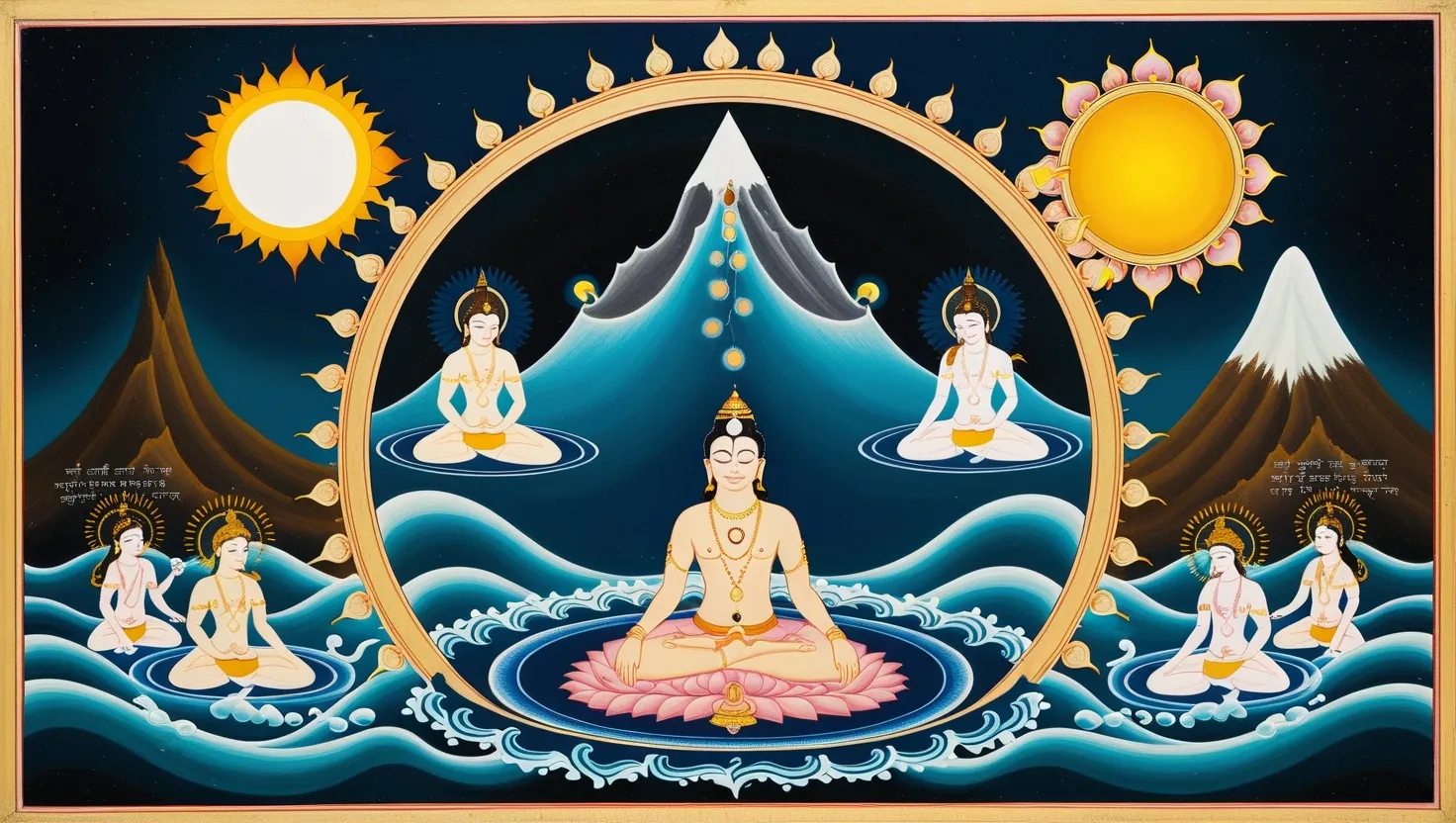
When I first read Vedic stories as a child, I thought they were about sky gods throwing weapons and strange demons hoarding rivers in the clouds. Only much later did it click: these battles are just as much about what is happening inside my own head as in some faraway heaven. In this article, I want to talk to you as simply and directly as possible, as if we are sitting together and asking: what if every god and every demon in these stories is actually a thought, a mood, a fear, or a hidden strength inside us?
Let’s start with a simple question: when you think of “gods” and “demons,” do you see two totally separate teams, like good vs evil in a movie? If yes, I’d invite you to hold that idea very lightly. In the Vedic way of seeing, devas and asuras are not always pure good and pure bad. They are more like different forces of the mind and life: some bring clarity, some bring confusion, and all of them are powerful. Inside you, they all exist at once.
One of the most powerful images is Indra fighting Vritra. On the surface, it’s a storm god fighting a giant serpent who has trapped the waters. But think for a moment about a very simple human experience: you know you need to act, you know you need to speak the truth, you know you should start that work, but you feel stuck, heavy, dull, almost like your energy is locked up somewhere deep inside. That tight, coiled, “I can’t move” feeling is your inner Vritra. The “waters” in the story can be seen as your creativity, your feelings, your natural flow.
Indra’s thunderbolt, then, is not just a fancy divine weapon. It is that sharp, clear moment when you finally say, “Enough. I will do it now.” You know that moment? When you suddenly get up, send the message, make the call, apologize, or start the project you’ve been postponing for months? The energy that cuts through your excuses and fear is your inner Indra. In simple terms, Vritra is your inner resistance; Indra is your inner decision.
This is why one famous line from the ancient tradition hits so hard:
“When the mind is still, the whole universe surrenders.”
It sounds dramatic, but it points to something very practical: when the storm in your own head settles, the “demons” outside you lose many of their teeth. Have you noticed that problems feel ten times bigger when your mind is in chaos?
Now think about the story of the churning of the ocean of milk. Gods on one side, demons on the other, a mountain as the rod, a serpent as the rope, and they are all pulling back and forth to churn the ocean and bring out treasures. On the surface, it is a fantastic scene. But inside you, this is happening every day.
You have higher impulses: kindness, clarity, love, curiosity. You also have rougher impulses: jealousy, greed, anger, laziness. What do most of us try to do? We try to kill or suppress the “bad” parts and pretend they are not there. The myth shows something much wiser: the gods and demons work together to churn. They do not destroy each other first. They use their tension to produce something higher.
In your life, when you feel torn between two sides of yourself—say, the part that wants comfort and the part that wants growth—what if the goal is not to wipe out one side, but to use the tension between them to gain energy and insight? Think of all the great changes in your life. Didn’t they often start in some inner conflict? The “treasures” that come out of the churning—strength, patience, courage, even the nectar of deeper understanding—often arise when you stay with that tension instead of running away.
There is a beautiful modern echo of this in a classic quote:
“Out of chaos, find simplicity; from discord, find harmony.” — Albert Einstein
Read that again, but this time imagine the “chaos” and “discord” as your own mixed thoughts and feelings. The churning is not a mistake. It is a process.
Now let’s talk about Maya—not just as a word you may have heard, but as a real force in your daily life. In later stories, the asura architect Maya builds whole illusory cities. Inside you, the same happens all the time. Your mind builds stories: “Everyone is against me.” “I can’t change.” “If I fail once, I am worthless.” Have you noticed how solid these stories feel when you are caught in them? As if they are hard facts?
The victory over Maya in the Vedic sense is not about smashing the world and calling it fake. It is about seeing, very simply and clearly: “This is a story my mind is telling. It may have a little truth, but it is not the whole truth.” That small gap between the story and your awareness is like the light of a god entering the hall of illusions.
Let me ask you directly: can you remember a belief you held for years that turned out to be wrong or incomplete? The moment it cracked, did the world end? No. In fact, life usually became lighter. This is the kind of “victory” over Maya the myths point to—not blind denial of the world, but clear seeing.
Another powerful symbol is Soma, the sacred drink both gods and demons keep fighting over. Instead of thinking of it as a real drink, think of it as a special state of mind: a deep sense of joy, meaning, enthusiasm, and connection. That feeling when work flows, when you feel present with someone you love, when you are inspired by a simple walk or a song—that is your inner Soma.
Now notice something important: both your “higher” and “lower” sides want that feeling. Your healthy side seeks it through learning, service, creativity, honest love. Your needy side tries to grab it through addiction, mindless scrolling, over-eating, chasing praise. The myths where Soma is stolen and taken back show what happens when one side of your personality tries to monopolize joy. When your life becomes only about one thing—only success, only pleasure, only control—Soma “disappears.” You might have comfort, but no taste.
So here is a simple question: when you feel dull and dry inside, where has your Soma gone? Which part of you has hijacked it? Often, just seeing that “Oh, my fear has taken over my joy” is already a small act of recovery.
Now consider a later figure rooted in these ideas: Ravana, the ten-headed king. People often say he is just a villain, but look closely: ten heads, immense knowledge, huge power, but no inner unity. Each head can be seen as a different voice in your mind: desire, pride, anger, doubt, logic, tradition, fear, and so on. When these voices do not talk to each other, you may become very smart yet still act against your own long-term good.
Have you ever done something where one part of you was saying, “This is wrong,” but another part said, “Do it anyway,” and you followed the second? That is your inner Ravana in action. The problem is not that you have many voices. The problem is that they are not in honest conversation, and there is no clear center to guide them.
A powerful line that captures this is:
“The mind is its own place, and in itself can make a heaven of hell, a hell of heaven.” — John Milton
Ravana’s fall is not just punishment. It is a warning: raw ability without integration collapses. The task in our own lives is to gradually bring our ten “heads” into some kind of council, where they can disagree but still serve one deeper intention.
Now think about the daily journey of the sun, Surya, and how he is struck by the demon Svarbhanu, causing an eclipse. On the outside, this explains an astronomical event. On the inside, it is something you already know very well. Some days you are clear, bright, awake. Then suddenly, for no obvious reason, you feel covered by gloom, confusion, or doubt. It is as if your inner sun has been swallowed. You may ask yourself in those moments, “Why am I like this? Why can’t I stay clear?”
The myth offers a gentle answer: this rhythm is natural. Clarity comes and goes. What matters more is whether you start believing that the darkness is permanent. Every evening is followed by morning. In the same way, every inner eclipse eventually passes if you don’t cling to it and keep feeding it with fearful thoughts.
So when you are in a low phase, instead of thinking “Something is wrong with me,” you might try asking, “What if this is just my Svarbhanu moment? Can I wait and keep a small lamp of awareness on, until my inner sun appears again?”
All of this leads to a very important shift: we stop thinking of devas (gods) and asuras (demons) as two fixed armies and start seeing them as different ways our life-energy can express itself. Anger, for example, can burn relationships when blind, but can also fuel courage when guided. Desire can trap us in endless craving, or it can push us toward genuine growth. Fear can freeze us, or it can make us careful and humble.
Some Vedic thinkers even hinted that asuras are just devas who have “forgotten” what they really are. Look inside: how many of your worst habits started as something healthy that got twisted? The urge to protect turned into control. The need to rest turned into laziness. The desire to connect turned into addiction to approval.
The task, then, is not brutal self-rejection. It is gentle re-education. Instead of shouting at your anger, you might ask, “What are you trying to protect?” Instead of hating your fear, you might ask, “What are you trying to warn me about?” This shift from “enemy” to “misguided ally” is one of the deepest psychological lessons hidden in these stories.
At this point, you might wonder: this all sounds interesting, but how does it help me when I am just procrastinating, arguing, or scrolling my phone? Let’s bring it down to very simple, daily examples.
You sit down to work, and suddenly you feel heavy and sleepy. You start checking unrelated things, then videos, then messages. If you see this only as “I’m lazy,” you will just feel guilty. But if you see it as a small Vritra holding your waters, you can ask: “What am I afraid will happen if I just focus?” Often there is a fear of failure, judgment, or boredom. The moment you see that fear clearly, you are already lifting Indra’s thunderbolt. One honest decision—“I will work just for ten minutes”—is that inner stroke of lightning.
Or you catch yourself making excuses after hurting someone: “They deserved it,” “I was just being honest,” “If I apologize, I will look weak.” That is Maya building a shining fake city around your ego. Instead of fighting yourself with harsh words, you might just smile inside and say, “Okay, Maya, nice try. But let me look again.” One simple, sincere “I’m sorry” becomes a god-like act breaking illusion.
Or you feel totally fragmented one day. One part of you wants to study, another wants to socialize, another wants to avoid everyone, another wants to change jobs, and so on. That is your inner Ravana day. Instead of forcing one voice to win, sit down and literally ask yourself: “Okay, everyone inside, what do you want?” Write it out if needed. You might be surprised how much calmer you feel when each “head” is allowed to speak. Out of that, a more balanced choice often appears.
There’s a line often linked to inner work that fits the Vedic mood perfectly:
“The longest journey you will ever take is the 18 inches from your head to your heart.”
All these myths, when read inwardly, are about that short but difficult journey. They give us pictures, so that our invisible struggles feel less random and more meaningful.
In simple words, you can think like this:
Inside you, there is a whole Vedic universe. Indra is your clarity. Vritra is your stuckness. The ocean of milk is your deep mind being stirred by life’s ups and downs. Gods are your nobler impulses. Demons are your raw, intense energies that need guidance. Soma is your deep joy. Maya is your self-deception. Ravana is your scattered mind. Surya is your basic awareness, sometimes bright, sometimes covered.
The goal is not to kick anyone out. The goal is to slowly help all these inner characters remember that they belong to one larger “you,” one wider awareness that can hold them all. When you start seeing your own moods and habits in this way, even your worst days become part of a bigger story, not just random pain.
So let me end with a simple, direct question for you: the next time you feel stuck, scared, angry, or strangely joyful, will you be willing to pause and ask, “Which god or demon is active in me right now, and what are they trying to do?”
If you keep asking that, gently and honestly, your own life—ordinary as it may look from the outside—starts to feel like a living Vedic myth being acted out inside your own mind. And slowly, quietly, the war between gods and demons turns into something else: an ongoing, patient work of making friends with every part of yourself, until the battlefield itself begins to soften.