The Weight of Silence: When Words Were Withheld in the Mahabharata
I want to start by asking you something simple: have you ever noticed how the most powerful moments in your life often happen in silence? Not the loud, dramatic kind of silence you hear in a movie theater, but the real kind—the pause before a difficult conversation, the quiet moment when you realize you’ve made a terrible mistake, or when you choose not to say something you could have said.
The Mahabharata, one of humanity’s oldest and longest stories, understands this perfectly. This ancient Indian epic isn’t really about what people said. It’s about what they didn’t say. It’s about the moments when characters opened their mouths and then closed them again. These silences shaped wars, destroyed families, and changed the course of history.
Think about it this way: if the Mahabharata were a piece of music, the silence between the notes would be just as important as the notes themselves. The quiet spaces tell us just as much as the dramatic speeches. Sometimes what a character refuses to speak becomes more powerful than any declaration they could make.
The Moral Weight of Staying Quiet
Let me tell you about Bhishma, one of the most respected figures in the entire story. Picture this: a woman named Draupadi is publicly humiliated in a crowded court. She’s dragged by her hair. Her dignity is attacked. Hundreds of people watch. And Bhishma, the eldest warrior, the man everyone respected above all others, says nothing.[1]
This isn’t just an uncomfortable moment. This silence has consequences. When the most powerful person in the room chooses not to speak, everyone else feels permission to stay quiet too. Bhishma’s silence didn’t just fail Draupadi—it sent a message to every other elder that this kind of treatment was acceptable. His refusal to use his voice was like handing a weapon to the people committing the injustice.
Here’s the difficult truth that many people don’t want to hear: staying silent when you have the power to speak is a choice. It’s not neutral. It’s not harmless. When you watch something wrong happen and say nothing, you’re actually making a statement. You’re saying that your comfort, your safety, or your reputation matters more than standing up for someone else.[1]
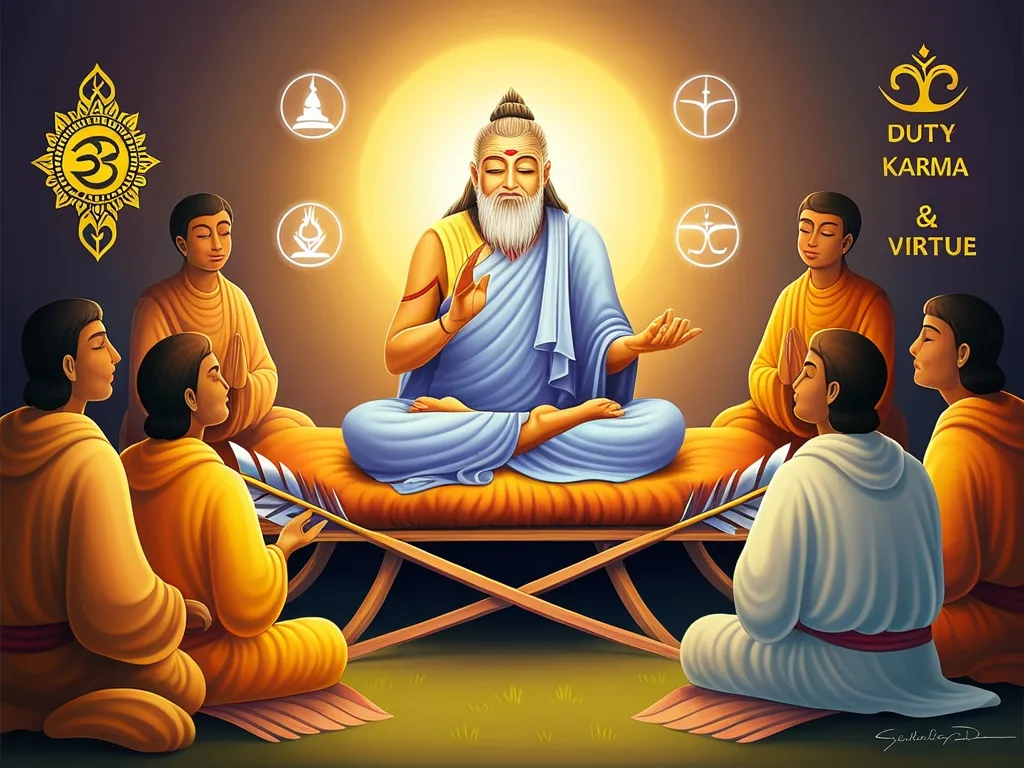
Bhishma was bound by an ancient vow to protect the throne. This vow trapped him. His promise to be loyal meant he couldn’t challenge the people in power, even when they were doing terrible things. So he chose silence as a way to manage his impossible situation. But this teaches us something important: sometimes our commitments and promises can paralyze us. Sometimes the oath we took years ago keeps us from doing what’s right today.
What if Bhishma had spoken? What if one powerful voice had broken the silence? We’ll never know because he stayed quiet.
A Mother’s Secret and Its Terrible Cost
Now let me introduce you to Kunti, a mother who carried a secret that would eventually destroy her family. Years before the main story begins, Kunti gave birth to a boy. But she couldn’t keep him. So she put him in a basket and sent him down a river. She told no one. She said nothing. For decades, this silence sat inside her like a stone.
The boy, named Karna, grew up as a charioteer’s son. He believed this was his true identity. He never knew his real mother or his royal brothers. When he finally met his family as a young man, no one recognized him. He didn’t know them either.[1] Kunti watched her firstborn from a distance, unable to claim him, unable to explain, unable to do anything but remain silent.
Her silence was meant to protect her honor and her reputation. But what did it actually protect? Nothing good. It condemned Karna to a life of confusion about who he really was. It set him up for a tragedy that would eventually lead to his death at the hands of his own brother.
Here’s the really hard part: when Kunti finally broke her silence and told Karna the truth, it was too late. The moment that could have saved him had already passed. He was already committed to the wrong side. Her revelation came not as salvation but as a cruel joke. The timing made her honesty into another form of betrayal.[1]
This is something we don’t talk about enough. Silence has a shelf life. The right words at the wrong time become the wrong words. A truth that would have changed everything five years ago might destroy everything today.
Using Silence as a Weapon
Krishna, one of the central figures in the Mahabharata, was brilliant at using silence as a tool. Before the great war began, Krishna went on a peace mission to the court of the enemy. He could have given speeches. He could have argued his position. Instead, he listened more than he spoke.[1]
Krishna was quiet because he was observing. He watched Duryodhana’s arrogance. He watched the old king’s weakness. He noticed who spoke and who stayed silent. He absorbed all of this information without revealing his thoughts. His silence gathered intelligence. It also created space for the other side to reveal themselves completely.
Think about how different silence can be from one person to another. Bhishma’s silence was passive—a failure to act. But Krishna’s silence was active—a deliberate strategy. He knew that sometimes revealing nothing is more powerful than revealing everything. He understood that silence can be a weapon if you know how to use it.
“In a lifetime, the words we regret are often not the ones we speak, but the ones we withhold.” — This truth echoes through every page of the Mahabharata.
The Courage in Taking Time to Think
Yudhishthira, the eldest of the five brothers, faced a mysterious figure called the Yaksha who asked him riddles in exchange for his brothers’ lives. When the Yaksha asked the final question, Yudhishthira didn’t rush to answer. He paused.[1]
This pause was different from the silences we’ve discussed so far. This wasn’t cowardice or strategy. This was thoughtfulness. Yudhishthira was considering the complexity of what he was being asked. He understood that some questions demand deliberation. He wasn’t going to blurt out an answer just to break the silence.
His hesitation came from wisdom. He knew that his brothers’ lives depended on careful thinking, not quick responses. When he finally did speak, his answer was careful and considered. He admitted that he didn’t have absolute certainty. This honesty, born from his willingness to sit with the question rather than rush to answer, is what saved them.
Compare this to what happened earlier when Yudhishthira made a reckless bet during a dice game. He didn’t pause then. He didn’t take time to think. He wagered his brothers, his wife, everything—and lost it all. The difference between the man who thought carefully and the man who acted impulsively shows us how the quality of silence matters.
Do you see the pattern? Some silence reflects cowardice. Some silence reflects wisdom. Some silence reveals strategy. But all silence reveals character.
The Explosion After Silence
Draupadi experienced a particular kind of silence. When she was dragged into the assembly hall, she was initially speechless. The shock of what was happening froze her words. But this wasn’t passive silence. This was the quiet before the storm.
In that space of silence, something shifted inside her. The disbelief transformed into fury. The paralysis transformed into purpose. When she finally spoke, her voice carried the weight of everything she hadn’t said. She asked a question that would echo through history: “Is there anyone here who will uphold justice?”[1]
This question changed everything. It broke the silence that the other elders had maintained. It forced people to confront their own complicity. Her words, made more powerful by the silence that preceded them, became the moral center of the entire war that followed.
Sometimes silence isn’t weakness. Sometimes it’s the gathering of strength. The quiet before Draupadi spoke was like the silence before a storm—full of energy, full of intention.
When Everyone Stays Quiet Together
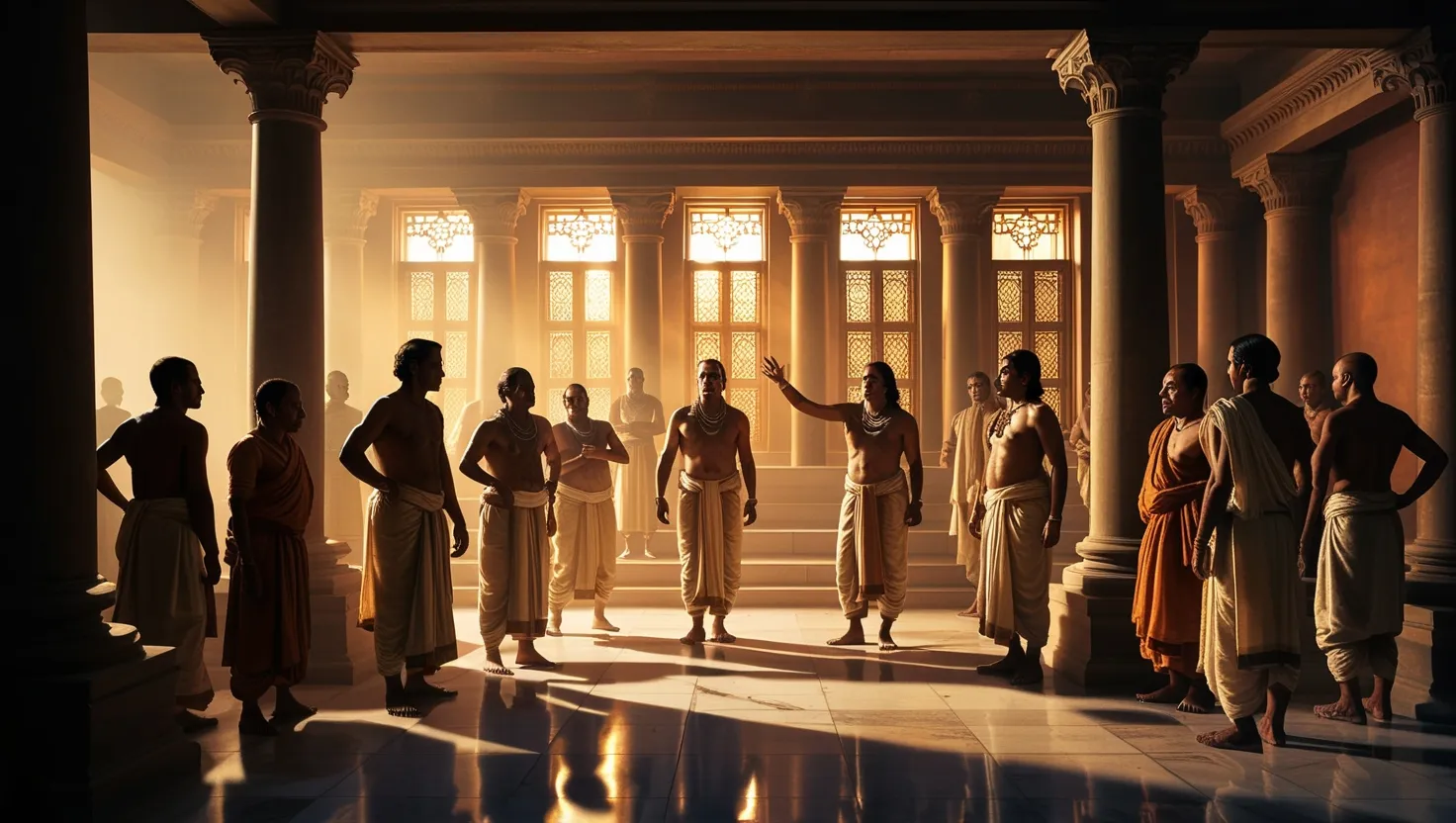
The collective silence of the court elders during the dice game created something toxic. When Yudhishthira gambled away everything, including his wife, no one spoke. When Draupadi was humiliated, no one spoke. When adharma—injustice, wrongdoing—was happening right in front of them, the elders maintained their silence.[1]
This teaches us something uncomfortable: when a group of people stays silent together, they create permission for terrible things to happen. Each person probably told themselves that it wasn’t their responsibility to speak. Each person assumed someone else would say something. But no one did. And in that collective silence, evil took root.
Imagine if just one elder had stood up and said, “This is wrong.” Would it have stopped everything? Maybe. Maybe not. But the silence itself was a form of participation. The absence of objection became a form of approval.
The Stories We Never Hear
The Mahabharata contains many gaps. There are moments where the story suddenly jumps, and we never learn what happened in between. One of these crucial silences involves Krishna and Karna meeting before the great war. These two figures had a conversation that the epic doesn’t record. We never hear what was said. We never know what truth might have been exchanged.
This silence is perhaps the most interesting of all. What happened in that unrecorded moment? What words were spoken that the story doesn’t share with us? The gap itself becomes important. It makes us realize that there might be other versions of this story, other truths that weren’t written down, other moments of silence that shaped history in ways we’ll never fully understand.[1]
The Burden of Proud Silence
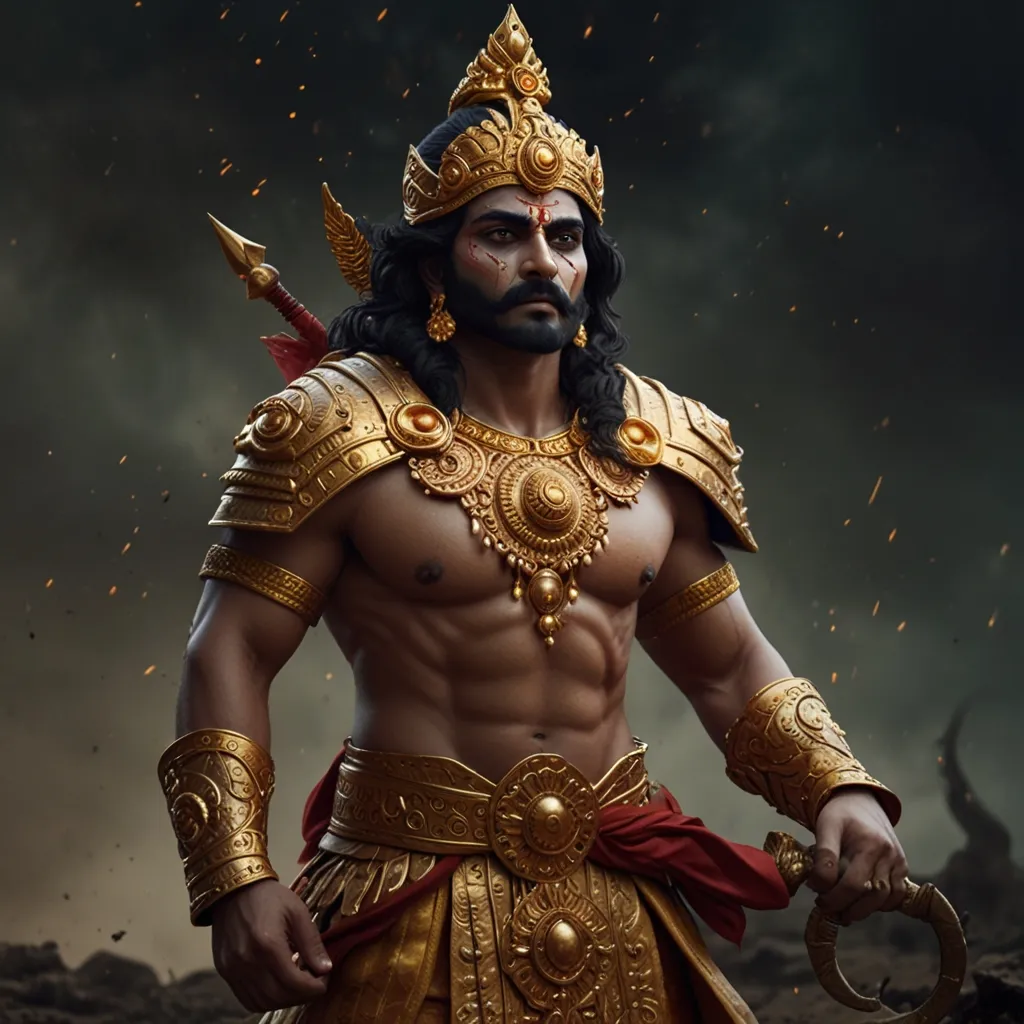
Karna spent most of the Mahabharata staying silent about his own pain. People insulted his low birth. They questioned his worth. They dismissed him as unworthy. And most of the time, he said nothing. He bore their cruelty without revealing that he was actually royalty, actually worthy of respect.
His silence came from pride. He wanted to be seen as a self-made warrior, someone who had earned his place through courage and skill, not through birth. But his proud refusal to speak about his truth also prevented reconciliation. His brothers never knew who he really was. His mother never got to truly claim him. His silence protected his dignity but also guaranteed his isolation.
Here’s the painful reality: sometimes the silence we choose to maintain our pride becomes the barrier that prevents us from connecting with the people we love. Karna’s refusal to speak his truth cost him everything.
Why This Matters to Us Today
The Mahabharata isn’t just an ancient story. It’s a mirror held up to human nature. When we read about Bhishma’s silence during Draupadi’s humiliation, we should ask ourselves: when have I stayed silent when I should have spoken? When we read about Kunti’s decades of secrecy, we should consider: what truths am I keeping from the people I love, and what is that costing us?
The story teaches us that silence is never empty. It’s never neutral. Every moment we choose not to speak, we’re making a choice. That choice has consequences. Sometimes silence is wise. Sometimes it’s cowardly. Sometimes it’s strategic. But it’s never without meaning.
The Mahabharata shows us that the words we don’t speak often matter more than the words we do. The silences between the grand declarations, the moments when characters pause instead of acting, the truths that remain hidden—these are often the most important parts of the story.
What would have changed if Bhishma had spoken up? What if Kunti had told her son the truth earlier? What if the court elders had broken their silence? These questions hang in the air, unanswered, teaching us that our words and our silences have weight. They matter. They shape the world around us in ways we might never fully understand until it’s too late to change them.