How Animals Shape Destiny and Dharma in the Mahabharata Epic
Discover how animals in the Mahabharata aren't just symbols but destiny-shapers—from Arjuna's divine horses to Yudhishthira's loyal dog. Explore hidden wisdom.
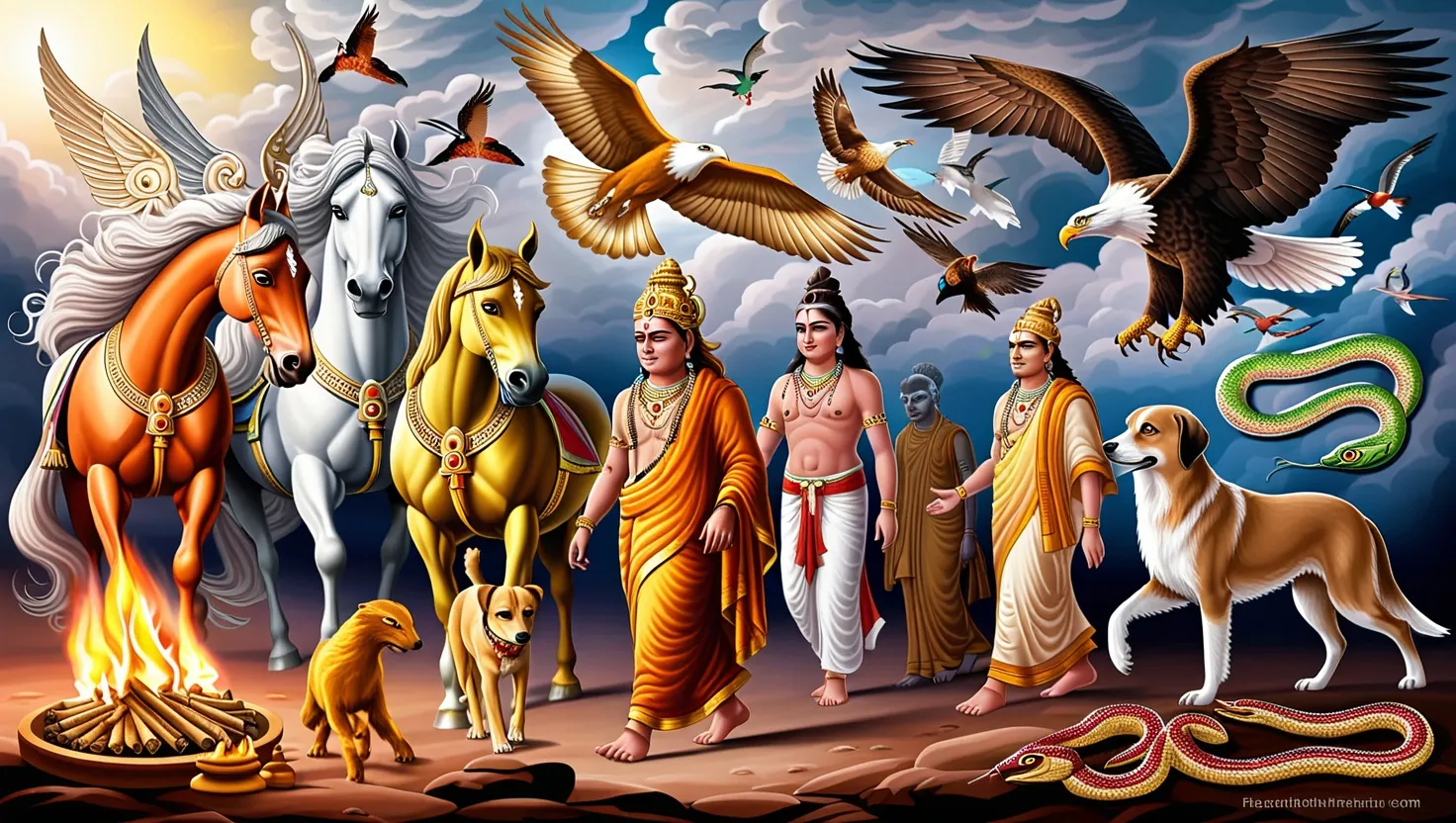
You and I have always walked the world alongside animals. There’s something quietly humbling about the way every epic, every civilization’s canon, gives its animals both a voice and a role in shaping fate. Nowhere is this more textured, more profoundly woven, than in the Mahabharata. I want you to pause and consider: What if the creatures dotting this story’s edges weren’t props, but agents of destiny themselves? What does it say about us, if the animals we often take for granted are the very keepers and shapers of our greatest stories?
“Until one has loved an animal, a part of one’s soul remains unawakened.” — Anatole France
From the moment the Mahabharata’s drama opens, animals are not just companions or symbols but conscious participants. Horses, for instance, are far more than mere beasts of burden. Think of Arjuna’s celestial horses—gifted by Agni, the fire god. These horses aren’t just fast; they represent a union of divine will and mortal action, guiding Arjuna through the fog of war and doubt. When we see Ashwatthama, desperate and hunted, sacrificing his own horse to escape, the story quietly asks whether the animal is the one being sacrificed, or whether the blurring of human and animal in flight is itself an act of survival that transcends species.
Ask yourself: When does a horse cease to be a horse and become the spirit of war, loyalty, even despair?
The notorious mongoose at Yudhishthira’s Ashwamedha sacrifice isn’t just comic relief. It’s a trickster and a critic, challenging the very foundation of ritual. Imagine the scene—the echoes of countless horses sacrificed in elaborate rites, the earth itself trembling with sanctified violence—and suddenly, a talking mongoose arrives. Instead of praising the king, it tells a humble story about a poor Brahmin, a handful of barley, and a selfless act that, in the mongoose’s view, outweighs the grandeur of royal sacrifice. The mongoose’s golden half, glinting in the firelight, mocks our obsession with scale and spectacle.
Here, I see an animal as the mirror of conscience. When was the last time you let a small act of kindness outweigh the noisy rituals of achievement in your own life?
The Mahabharata never allows its narrative to drift far from questions of transformation, and the line between human and animal is porous. Shikhandi, whose destiny as a warrior is deeply entangled with a previous life as Amba, underscores this fluidity. The Yaksha’s intervention, a female boar’s appearance, and shapeshifting creatures all remind us that identity, in this world, is not fixed. The animal is not always other; sometimes, it is us, and we are it, each acting as vessels for cosmic justice.
What does it mean when the instrument of your revenge, or your redemption, is an animal? Does destiny wear a human face, or is it draped in feathers and fur?
Birds, for many readers, serve as the overlooked witnesses in the crowd. But if you pay attention, you’ll notice they carry vital secrets. Hawks and kites fly above the battlefield, their patterns interpreted as omens. Sometimes, the meaning is clear—a cry at a crucial moment, a shadow over a chariot. At other times, Dhritarashtra’s hope for a sign of Duryodhana’s victory rests on the ambiguous call of a bird. We might ask: Are these animals mere symbols, or are they themselves agents, subtly bending human hearts and actions with each movement?
“The greatness of a nation and its moral progress can be judged by the way its animals are treated.” — Mahatma Gandhi
Perhaps the epic’s most haunting animal companion is the dog that follows Yudhishthira on his final journey. After the dust of war, as kingdoms fall silent, all that remains is the king and a stray dog. When Indra descends in his chariot to offer heaven, Yudhishthira refuses unless the dog can come with him. Only then does the animal reveal its true form: the god of dharma himself. Loyalty, humility, and righteousness are revealed not on the battlefield, but at the side of a tired dog on a lonely road. This moment, for me, is the Mahabharata at its most distilled—virtue emerging in the smallest, most easily overlooked companion.
Have you ever had a moment where your greatest test came disguised as an ordinary creature asking nothing but companionship?
Let’s not forget the animals that serve as vehicles for divine intervention. Garuda, the mighty eagle, doesn’t just transport Krishna—he is an expression of transcendence and vision, a ferry between heaven and earth. Serpents, too, are everywhere: some are agents of fate, others bearers of boons or curses. Agni’s hunger for the Khandava forest ignites an apocalyptic firestorm, driving multitudes of animals before it. Who is the victim here, who the villain? The Mahabharata refuses to provide simple answers, instead inviting us to see the world as a web where gods, beasts, and humans must all negotiate power and responsibility.
A story that often escapes classroom discussion is the one involving Shalya’s horses—driven to exhaustion, transformed by magic, and reflective of the immense toll of leadership. Are these just animals, or are they projections of the human cost of ambition? The boundaries dissolve, and we’re left to wonder whose agony is being narrated and whose fate is truly at stake—the horse or its master.
Do the animals in the Mahabharata simply serve human interests, or do they teach us, in their suffering and resilience, what it means to be truly alive?
In a lighter vein, consider the nagas—serpent beings who are at once feared and revered. When Janamejaya, seeking vengeance for his father’s death, organizes a massive snake sacrifice, even the gods are alarmed. The serpent world intervenes with cunning and compassion, revealing layers of storytelling that treat animals as kin, adversary, and guide. The nagas have agency, speak for themselves, and change the course of human history.
“If having a soul means being able to feel love and loyalty and gratitude, then animals are better off than a lot of humans.” — James Herriot
When I look at the Mahabharata through this lens, I see that animals are not just present, they are necessary. They question, test, and sometimes redeem their human counterparts. Even the most fleeting animal encounter in the epic—an anxious flock circling a burning forest, a single swan gliding across a lotus pond—carries a weight of meaning that transcends its immediate context.
What would it mean for us, as modern readers, to truly honor the silent witnesses of our own lives? Could we, like Yudhishthira, refuse paradise if it means abandoning even the smallest creature that has walked beside us?
Here’s the twist: the animals in the Mahabharata don’t simply reflect the characters’ moral states; they shape them. They are teachers, provocateurs, and sometimes the catalysts for cosmic justice. To read the epic without noticing its animals is to miss half its story. For every mighty warrior, there is a horse echoing his fatigue. For every king, there is a dog offering loyalty without condition. For every ritual, there is a mongoose asking if our gestures mean what we think they do.
I invite you to look again, to listen for the animal voices threaded through the world’s oldest stories. Ask yourself: How might your own destiny be shaped by the animals, silent or not, who cross your path? The Mahabharata asks us to remember that destiny is never just a human affair. Animals, with their quiet wisdom and unspoken questions, wait at the crossroads. Sometimes, their presence is the true test of our soul.
In the words of Albert Schweitzer:
“In the hope of reaching the moon, men fail to see the flowers that blossom at their feet.”
Maybe, just maybe, the animals aren’t silent at all. Maybe we just haven’t learned how to listen.