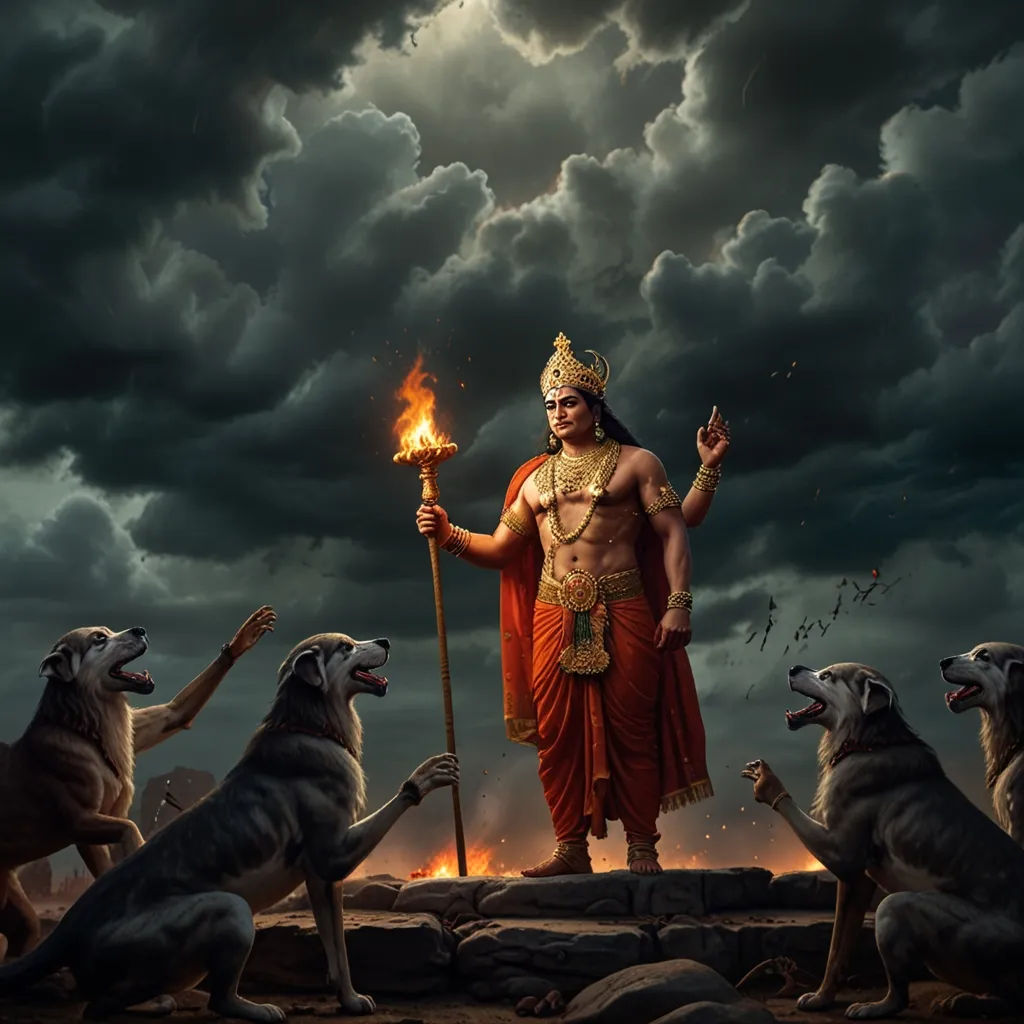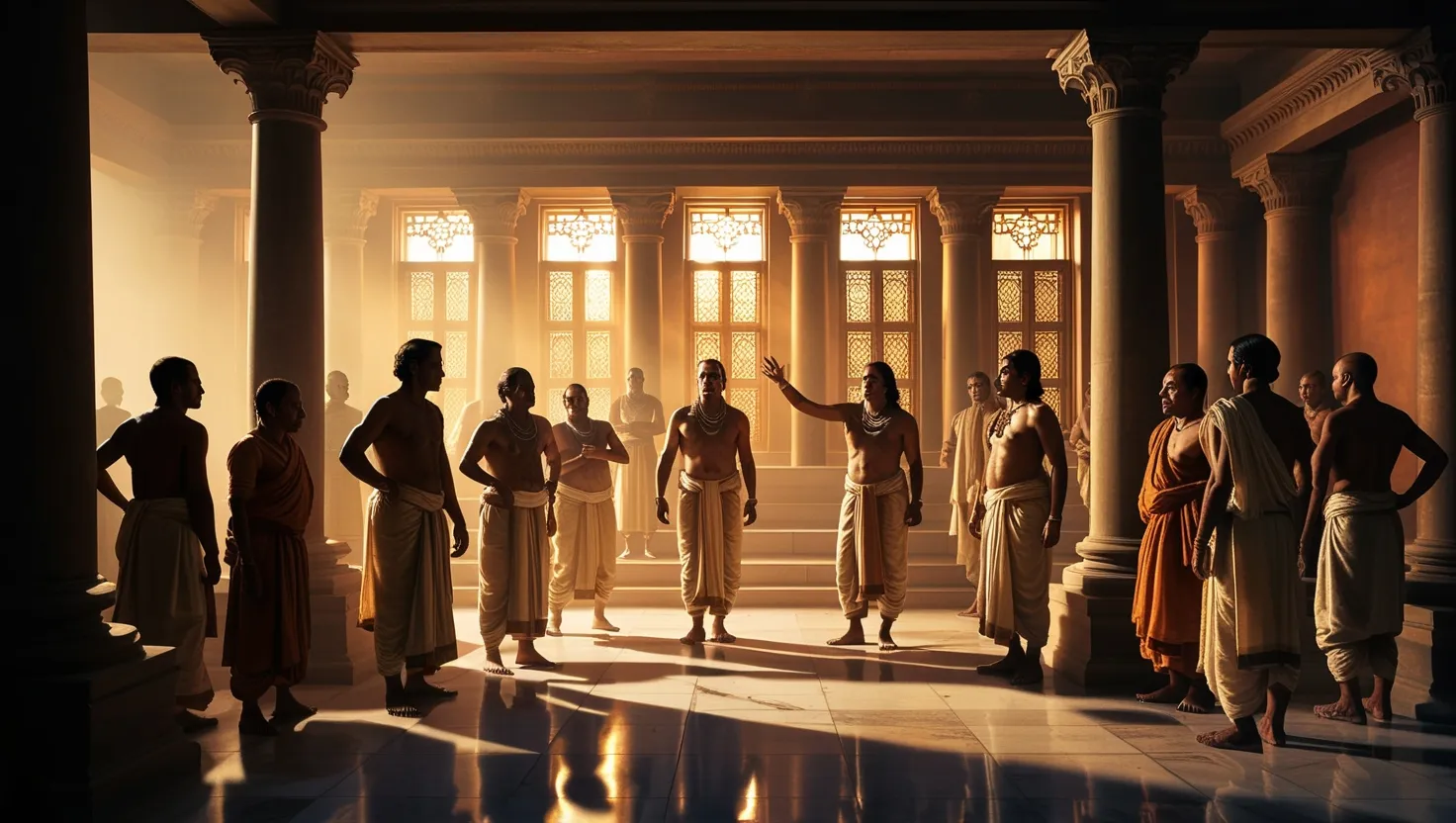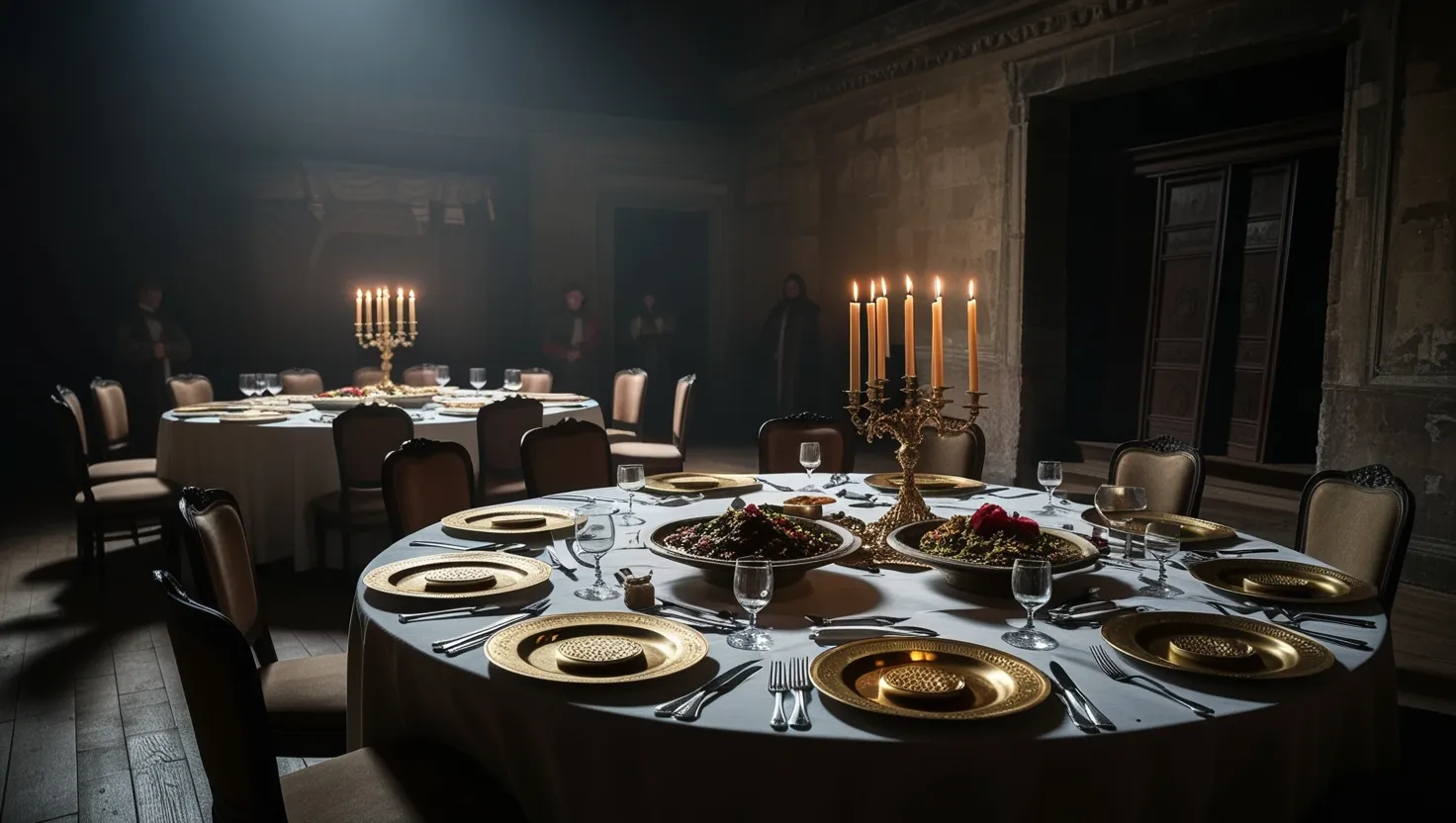
Food in the Mahabharata is never just food. It is a quiet judge, a stage for pride and shame, a way to bless and a way to destroy. If you and I sit with this epic and look only at who eats, who serves, who refuses, and who fasts, a whole new picture of power begins to appear.
Let me start with a simple idea: in the Mahabharata, a plate is often more dangerous than a weapon. Does that sound odd? We usually think of war, bows, and chariots. Yet again and again, a meal starts a chain of events that ends in blood.
The famous dice game is a clear case. On the surface, it is a royal festival, with food, drink, and courtly honor. Duryodhana invites Yudhishthira as a guest, not as an opponent. The hall is set like a celebration, full of the softness of music and the comfort of shared dishes. But behind this warmth sits Shakuni’s cold plan. Here, hospitality is not kindness; it is bait. The feast is the sugar that hides the poison of the dice. I want you to notice something simple but sharp: Yudhishthira does not walk into a battlefield; he walks into a dining hall. His fall begins not with an arrow, but with an invitation.
This is one of the strange powers of food in the epic. A feast is supposed to make everyone equal for a while. When we sit to eat, the king and the farmer both lift food to their mouths. But Duryodhana turns that shared space into a trap. The rule of the host — to protect, to give, to respect — is twisted into its opposite. Have you ever felt that someone’s “welcome” was not really a welcome? That feeling sits at the heart of this scene.
Before that, there is another feast-related wound that shapes the story: Duryodhana’s humiliation in the Palace of Illusions at Indraprastha. The palace is prepared for a celebration, for guests, for royal joy. Floors look like water, pools look like stone. Duryodhana, already insecure, misreads what he sees. He thinks a polished crystal floor is a pool and lifts his clothes; people laugh. He thinks a pool is a floor and falls in; people laugh again. The laughter bites deeper than any weapon.
The pain here is not hunger of the stomach but hunger of respect. He had come to a feast expecting honor and left with mockery stuck in his mind. Many people remember only the magic of the palace, but the more important part may be the bruised ego that walks out of it. The anger that later fuels the dice game is cooked slowly in that hall of illusions. It is as if one wrong step at a royal feast seasoned the whole war with resentment.
There is a quieter, more tender side to food in the forest years of the Pandavas. During their exile, they receive the Akshaya Patra, the pot that never runs out of food — but only until Draupadi eats. At first glance, it sounds like a simple miracle: a magic vessel that feeds everyone. But think about the rule. The pot is full as long as everyone else has been served before Draupadi. The moment she eats, it stops for the day.
This means their survival rests on a daily act of self-control from the person who already carries the heaviest emotional load. Everyone must hurry to eat so that she can eat last. Every day, she must delay her own hunger to keep the miracle working. Can you imagine living like that, constantly checking, “Has everyone eaten? Is anyone still left?” Her plate becomes a clock. Time for others first, self later.
This is more than kindness; it is a training in humility for the whole household. No one can afford to be careless with food. Waste is not just rude; it risks divine support. A late guest is not an annoyance; they hold the power to stop the day’s grace. I find this detail very striking: a god’s gift, but with a human condition — your miracle depends on how you treat each other at mealtime.
Then comes the visit of the sage Durvasa, famous for his quick temper. He arrives with his students after Draupadi has already eaten. The pot is dry for the day. The danger here is not simply that guests might go hungry, but that failed hospitality can bring a curse strong enough to wipe out a family. In this world, to let a guest go unfed is to attack the order of the universe.
Krishna’s answer is strangely small and simple. He finds one grain of rice left in the pot, eats it, and says all beings are satisfied. The disciples of Durvasa feel so full they do not even return for a meal. This is not just a magic trick. It shows how, in the epic’s logic, the moral weight of feeding is larger than the physical measure of food. One grain, eaten by the right person with the right intent, is more powerful than a hundred plates served with pride or fear.
It also hides an uncomfortable question: what if Krishna had not come? The story reminds us that hospitality is a constant risk. The world is watching how you serve, who you feed, and how you respond when you are short. Do you make excuses? Do you share the last piece? Or do you try to hide your lack?
Food is also used to test charity, and no one is tested harder than Karna. He is famous for never saying no to a request. His identity as a giver is almost more important than his identity as a warrior. When Indra comes in the form of a Brahmin and asks for Karna’s armor and earrings — his natural divine protection — Karna still gives them. He knows he is making himself weaker in a brutal war. He knows the request is unfair. He gives anyway.
Here, alms are not about filling someone’s stomach. The “beggar” is a god in disguise, and the “gift” is not food or gold but safety itself. Karna’s generosity becomes a kind of fast in reverse. Instead of refusing food, he refuses security. His hunger is not for wealth or comfort but for honor — to die as the greatest giver. This is a different kind of appetite, one that eats away his chances of survival.
Ask yourself: when you give something away, what are you really feeding? The other person’s need, or your own image of yourself?
Fasting in the Mahabharata often works like that — not just as a spiritual practice, but as a way of saying something bigger without words. Bhishma, lying on a bed of arrows after the war, chooses to live on in pain until the right cosmic time, refusing food and water. People sometimes read this only as self-control. But it is also a message to the whole family and to the reader.
Here is a man who spent his life keeping vows tied to other people’s desires: his father’s love life, the throne’s stability, the kingdom’s rules. In the end, his last vow is fully his own. He decides when to eat (never again) and when to die. By fasting, he is saying, “This body that helped build and destroy dynasties is now under my command alone.” Food here represents the world’s pull — and he calmly steps away from it.
Compare that to Yudhishthira after the war. He has finally won the kingdom. The great feast of victory should follow. But he does not feel like eating at all. He says ruling feels like swallowing poison. The tables are full, but his heart is empty. This is one of the quiet shocks of the epic: the man who gambled away his wealth and honor for mere dice now cannot enjoy the feast that comes with ultimate power.
You and I are used to the idea that success tastes sweet. The Mahabharata quietly says: sometimes success tastes like ash. Yudhishthira’s lack of appetite is not just sadness; it is a moral signal. A feast built on the bodies of your cousins and teachers is not food; it is guilt on a plate.
In this sense, the epic often uses very simple eating images to talk about very complex desires. Listen to how often the language of hunger and taste is used for emotions:
Duryodhana is “hungry” for the throne. Shakuni “feeds” his anger with the dice. Draupadi’s vow is a “hunger” for justice that only blood can satisfy. The war itself is called a fire that “devours” armies.
Have you ever said, “I’m starving for attention” or “I can’t digest this insult”? The Mahabharata takes such phrases very seriously. For it, the most dangerous hungers are not in the belly but in the mind.
One famous line often repeated in thought and speech is:
“Man is what he eats.”
On the surface, this can mean that food shapes the body and mind. But in the world of the Mahabharata, it also flips around: what you “eat” in terms of choices, insults, praise, power, and pain slowly shapes who you become. Duryodhana keeps eating his own jealousy until it becomes his full identity. Karna keeps feeding his loyalty to Duryodhana until he cannot leave, even when he learns the truth about his birth. Draupadi feeds her anger until it finally consumes the Kauravas but leaves her without her sons.
Here is a question I often ask myself while reading: if each major character had to sit alone with a simple bowl of rice and name their true hunger, what would they say? Would Duryodhana admit he wants love more than land? Would Bhishma say he wants freedom more than duty? Would Yudhishthira say he wants peace more than justice?
The epic drops small answers in food scenes. When a person eats greedily, or refuses food, or breaks the rule of feeding guests, we see their deeper drives laid bare.
Even the way the text treats guests compared to family is revealing. Guests must always be fed first. The stranger’s stomach has higher priority than your own child’s, in principle. This sounds extreme. But it builds a world where your moral worth is constantly tied to how you treat those who are not “yours.” Food is the test. If the pot is small, who gets the last serving? That answer tells the truth about a house.
There is also another angle that people don’t talk about much: the gender of service. Draupadi is at the center of so many food-centered moments, yet her own hunger is almost always quiet. She eats last with the Akshaya Patra. She is the one expected to host Durvasa successfully. She feeds the Pandavas’ pride in public, then manages their fear and shame in private.
Her role reflects a pattern we still see: women as the ones who cook, serve, and make sure everyone else is fed, even when their own emotional and physical needs are not fully seen. If you pause on that, the gift of the Akshaya Patra has a sharp edge. It glows with divine support but also ties the family’s survival to the constant unpaid work of one woman’s care.
There is a strong saying often linked with duty:
“To feed the hungry is to serve the divine.”
In the Mahabharata, this is not just a nice thought. It is law. Not feeding the hungry risks curses. Feeding them properly can bring grace. But the story also asks: who feeds the feeder? Who watches the watcher? Who serves the one who always serves?
As the epic moves from feast to forest, from palace to battlefield, the use of food keeps shifting, but one rule holds: eating is never just about the body. The dice game is “wrapped” in a feast to pretend fairness. The humiliation in the crystal hall is “served” in a place meant for wonder. The Akshaya Patra feeds everyone, but only if Draupadi starves herself a little each day. Durvasa’s arrival shows how a single missed meal can invite cosmic danger. Karna’s giving shows how generosity can strip a person bare. Bhishma’s fast shows how refusing food can be an act of final control. Yudhishthira’s loss of appetite shows how victory can taste worse than defeat.
So when you read the Mahabharata next time, do not look first at who holds the bow. Look at who fills the plate. Who invites whom to eat? Who sits where at the table? Who is missing from the feast? Who walks away still hungry, not in body but in heart?
The epic seems to whisper a very simple lesson: we become the servants of the hungers we do not understand. Some people are ruled by the hunger for power, some by the hunger for honor, some by the hunger for fairness, some by the hunger for peace. Food scenes in the Mahabharata are like mirrors. They show which hunger is really in charge.
Let me end with a question for you to sit with: in your own life, if your daily meals were watched like the meals in this epic — who you eat with, who you serve, who you refuse — what story would they tell about your deepest desires?