Why the Kumbh Mela Sometimes Comes After 11 Years, Not 12
Jupiter circles the Sun in 11.86 years, not 12. We count Haridwar's Kumbh Melas from 1879 to 2021 to show why one comes a year early about every 83 years.
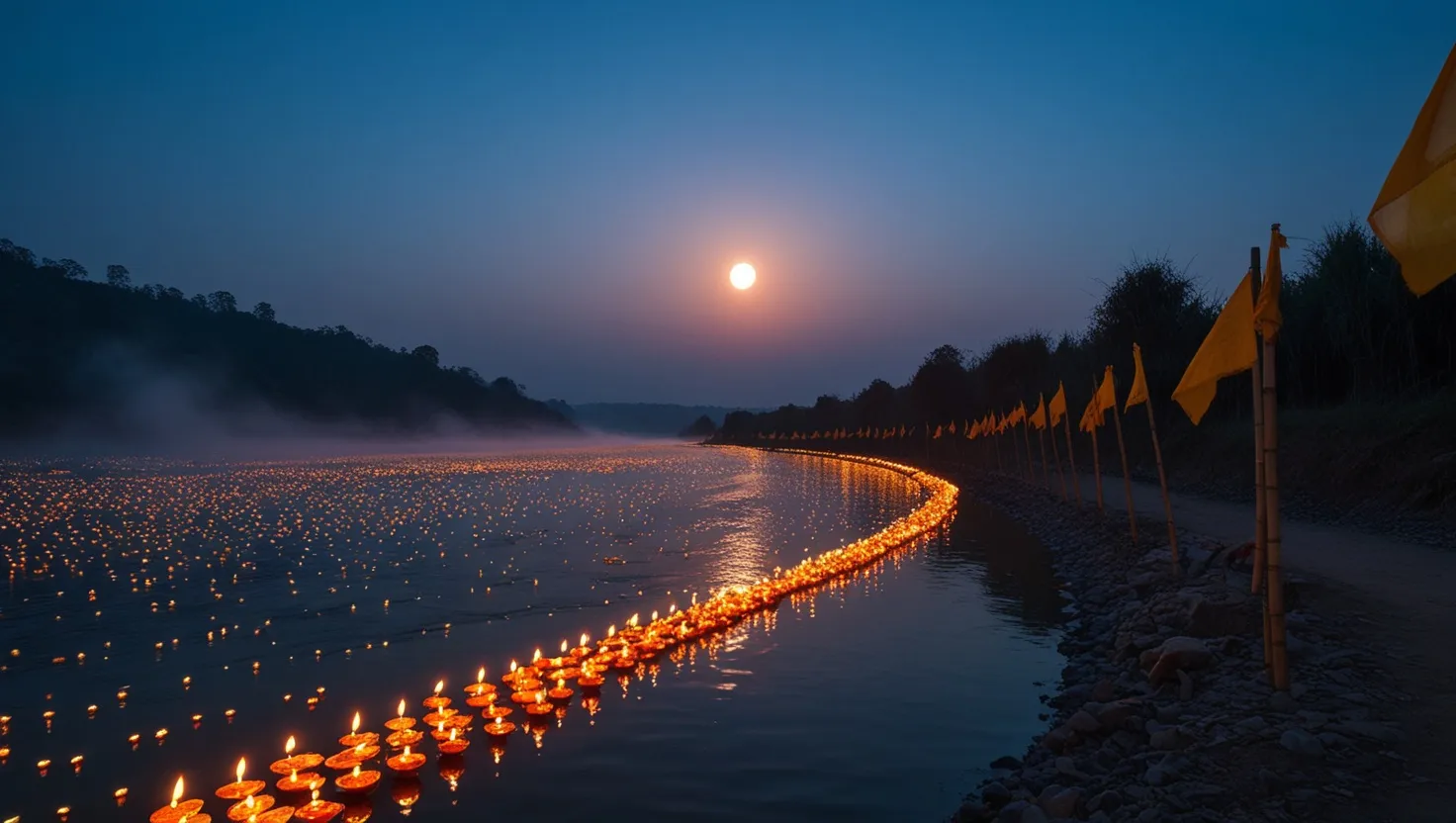
In April 2021 the sadhus of the akharas walked down to the Ganga at Haridwar for a Kumbh Mela that, by the old rule of every twelve years, wasn’t due until 2022.
The last one had been in 2010. Count on your fingers the way your grandmother taught you: 2010 plus twelve is 2022. Yet there they were, a year early, bathing in the river during the second wave of Covid. The decision drew heavy criticism at the time.
People wanted to know why. One answer came from Swami Avdheshanand Giri of the Juna Akhara. In 2020 he had said the mela should go ahead on schedule because Guru, the planet Jupiter, had picked up its pace. Another came from The Wire, which ran an opinion piece arguing that the country’s leaders had simply listened to astrologers.
Both answers missed the simpler and, I think, lovelier one. The Kumbh had come in its eleventh year before, in 1938. It will do so again. And the reason is sitting in plain sight in the sky, in a number that isn’t quite twelve.
What twelve means in the old story
Start where every Kumbh story starts, with the churning of the ocean.
In the Samudra Manthan, the devas and asuras churn the cosmic sea to bring up amrit, the nectar of immortality. When the pot (the kumbha) finally rises, a struggle breaks out over who gets to drink. In the telling most families know, the pot is carried away and drops of amrit fall at four places on earth: Haridwar on the Ganga, Prayag where the Ganga, Yamuna and the unseen Saraswati meet, Ujjain on the Shipra, and Nashik on the Godavari. Those four rivers carry their own long stories, and the four towns became points on what the Puranas turned into a living sacred map of India.
The twelve comes from the same story. The tradition holds that the struggle over the pot lasted twelve days of the gods, and one divine day equals one human year. So twelve divine days become twelve of ours. Families tell the churning a little differently, but that sum never changes.
That’s the story. The calendar is stricter. Each site’s mela is tied to where the planets stand. For Haridwar, the tradition sets the Kumbh for when Brihaspati, or Jupiter, is in Kumbha rashi (Aquarius) and the Sun is in Mesha (Aries). Nashik’s Simhastha takes its name from Simha (Leo), the sign Jupiter must be in. A Mughal-era text already links the Trimbak mela to Jupiter entering Leo.
Haridwar also keeps a half-step. Roughly six years after each full mela comes an Ardh Kumbh, the “half” Kumbh. The colonial record lists Haridwar’s in 1885, 1897, 1909, 1921 and 1933, each six years after a full one. That’s why you’ll sometimes hear of a Kumbh at Haridwar only six years after the last, and why it isn’t a mistake.
One detail matters here. These are the signs of the sidereal zodiac used in jyotisha (Indian astrology), fixed against the stars, not the tropical zodiac of Western horoscopes. The dates below follow the Lahiri system that most Indian panchangs use.
So the real rule is “when Jupiter comes back to this sign”, and twelve years is how people say that out loud. The question is how long Jupiter actually takes.
A planet that runs a little fast
Jupiter takes 4,332.589 days to go once around the Sun against the background stars, according to NASA’s Jupiter fact sheet. That’s about 11.86 years. In everyday terms, 11 years and roughly 10 months.
You may have read “11 years, 11 months and 27 days” on some sites. That works out to about 11.91 years, which doesn’t match NASA.
Now do the subtraction slowly. Twelve minus 11.86 leaves about 0.14 of a year, which is roughly seven weeks, so every time the mela is counted as twelve years, Jupiter has really come back about seven weeks sooner than the count assumes.
Seven weeks is nothing in one cycle. Nobody notices. But it piles up, cycle after cycle, quietly, the way interest piles up on a loan nobody remembers taking, and I find that the most satisfying thing about this whole question.
Picture a wall clock that gains seven minutes every twelve hours. For a day or two you’d shrug. After a week it’s showing the wrong hour. Keep ringing a bell by that clock and one day you’ll have to ring it a whole lap early, just to catch up.
Here is the catch-up, worked out. Seven of Jupiter’s orbits come to about 83.04 years. Seven twelve-year melas make 84. That’s almost a whole year. So somewhere in every seven cycles, one gap has to shrink from twelve years to eleven. Six gaps of twelve plus one gap of eleven gives exactly 83.
Remember that number. It’s about to turn up in the history books.
The ledger the cholera officers kept
We know Haridwar’s Kumbh years in the colonial era for a grim reason. British sanitary officials counted the cholera deaths at each mela. Those counts survive in a table now reproduced on Wikipedia’s Haridwar Kumbh Mela page.
They’re hard numbers. In 1891 the table records 169,013 cholera deaths, the worst year in the series. Behind every one of those was a family that had walked to the river for blessing. It’s sobering that the record of the mela’s rhythm comes to us through that grief.
Lay the years out, though, and look only at the spacing:
- 1879, 1891, 1903, 1915, 1927: twelve years apart, every time.
- 1927 to 1938: eleven years.
- 1950, 1962, 1974: inferred rather than documented, but twelve-year steps from 1938 land exactly on the known 1986.
- 1986, 1998, 2010: twelve years apart, all confirmed.
- 2010 to 2021: eleven years.
Now count from 1938 to 2021. Eighty-three years.
That’s the number from the clock. Six gaps of twelve, one gap of eleven, and the mela is back in step with Jupiter. In January 2021 Aaj Tak reported that the Haridwar Kumbh was coming in its eleventh year “after 83 years”. This is what sat underneath that headline, even if the piece’s own explanation got muddled.
Go back another 83 years from 1938 and you land on 1855. Shuddhabrata Sengupta’s piece in The Wire named 1855 as an earlier eleven-year Kumbh. That date rests on thin ground, so hold it lightly. It fits the pattern, which is all I’d claim for it. Earlier years get murkier still. A mela is recorded at Haridwar in 1760 and a cholera outbreak at the 1783 fair. Other dates from that century don’t sit neatly on any chain. I wouldn’t build anything on them.
So did Guru speed up? Not in any way an astronomer could measure. The orbit was 11.86 years in 1927 and in 2010. What changed was the count. The swami’s way of putting it is the way a tradition talks about the sky, and it isn’t wrong in spirit. Jupiter really did arrive “early” by the reckoning of twelve. It had just been arriving early, by seven weeks a time, all along.
Why 2021 and not 2022, down to the day
The average explains the pattern. The exact year comes down to something finer, and it’s my favourite part of the whole puzzle.
Jupiter doesn’t glide through a sign at an even pace. Seen from Earth, it sometimes appears to slow, stop and drift backward for a few months, which astronomers call retrograde motion. So it can step into a sign, slip back into the previous one, and then return.
That’s what happened around 2021. According to Lahiri panchangs, Jupiter entered Kumbha on 6 April 2021. It slipped back into Makara in mid-September, came back into Kumbha around 20 or 21 November, and finally moved on to Meena (Pisces) early on 13 April 2022.
Then there’s the second condition, the Sun in Mesha. The Sun crosses into Mesha in mid-April each year, at Mesha Sankranti. In April 2021, Jupiter was already in Kumbha when the Sun entered Mesha. Both conditions held.
In 2022, Jupiter left Kumbha on the morning of 13 April. Most panchangs put the Sun’s entry into Mesha on 14 April. One major panchang says the evening of the 13th, but either way Jupiter had already gone. The two conditions missed each other by about a day.
A day. That’s all. Over seven cycles the drift had grown to nearly a year, and by 2022 the sky’s window had closed just before the Sun arrived. If the mela was going to follow the rule at all, it had to be 2021. You can think what you like about holding it in the middle of a pandemic. But once you accept the rule, the sky didn’t leave much room for argument.
How old is the rhythm, really
The honest picture is more tangled than either the devotional or the sceptical version.
The phrase “Kumbha Mela” doesn’t appear in ancient or medieval texts. Its earliest known use is in the Khulasat-ut-Tawarikh, a history written in 1695, in connection with Haridwar. Gatherings at Haridwar are much older. Timur came through in 1398, possibly during a Kumbh. But the name and the full system came later than many of us grew up assuming.
Prayag is a sharper case. The historian Kama Maclean, in her book Pilgrimage and Power (2008), argues that the twelve-year Kumbh at Prayag was largely shaped in the nineteenth century. In that account, the first British reference to a “Coomb fair” there comes in an 1868 report, and the first Prayag Kumbh was organised in 1870. Earlier gatherings at the confluence were real and ancient, but they may not have run on this cycle.
I don’t think any of this takes anything from the bathers. Pilgrimage to holy waters is as old as Indian religious writing. Texts like the Skanda Purana are full of journeys to sacred tirthas. What changes is the claim about the clock. At Haridwar, the Jupiter rule and the record fit together beautifully. Across all four sites, the cycle is partly old and partly a later arrangement. Serious scholars still argue over how much is which.
As for who actually picks the year, there’s no single published rulebook that I know of. In 2021 you could see several hands at once. Akhara heads like Swami Avdheshanand Giri pressed for the date, astrologers read the panchang, and the Uttarakhand government ran the event. Then-chief minister Trivendra Singh Rawat said in July 2020 that the mela might see changes depending on the coronavirus situation. The sky set the window, and people decided what to do inside it.
Nashik, 2027, and the next early year
On 31 October 2026, President Droupadi Murmu unfurled the dharma dhwaja, the religious flag that opens the mela, at Ramkund on the Godavari in Nashik. On the same day, Chief Minister Devendra Fadnavis raised a flag at Kushavarta Tirth in Trimbakeshwar. The Nashik-Trimbakeshwar Simhastha Kumbh had formally begun.
Per Lahiri panchangs, 31 October 2026 was also the day Jupiter first entered Simha. It drifts back into Karka (Cancer) on 25 January 2027, returns to Simha on 26 June 2027, and moves on to Kanya (Virgo) on 26 November 2027. The main bathing days, the Amrit Snans, are reported for 2 August 2027, 31 August 2027, and 11 September at Nashik with 12 September at Trimbakeshwar. All of them sit inside that second Simha window. Earlier reports gave a different first date. If you’re planning to go, check the official schedule from the Maharashtra mela authorities rather than any article, this one included.
Nashik’s chain runs 2003-04, 2015, 2027, twelve years each, so there’s no eleven-year surprise in this cycle. Its turn will come. The seven weeks keep piling up at every site, because they belong to Jupiter, not to any one river.
At Haridwar, if the pattern holds, the next full Kumbh should come around 2033, twelve years after 2021. The next eleven-year gap would then fall roughly 83 years after 2021, somewhere near 2104. That’s arithmetic, not prophecy, and the panchang-makers of that century will have the final word.
There’s something fitting in this. Hindu thought has always measured time in cycles rather than straight lines, and the Kumbh turns out to be a small, exact proof of it. “Every twelve years” is the round number your grandmother gave you, and it’s true almost all the time. The sadhus at Haridwar in 2021 were following the slow, slightly uneven planet the round number stands for. So were the pilgrims in 1938, and so, perhaps, were those in 1855.