Ushas: The Vedic Goddess of Dawn and the Ancient Art of Beginning Again
Discover Ushas, the Vedic goddess of dawn, and how ancient sunrise rituals can reshape your mornings. Learn why watching the dawn may be the most powerful habit you can build.

There is something quietly extraordinary about the fact that thousands of years ago, people sat in the pre-dawn dark and composed poetry for the sunrise. Not because a king commanded it. Not because it was their job. But because the light arriving each morning felt like a miracle worth singing about.
The goddess Ushas is that miracle personified. She appears in more than twenty hymns of the Rigveda, the oldest surviving body of Sanskrit literature, making her one of the most frequently praised figures in the entire collection. She predates temples, organized religion, and written text. She belongs to a time when human beings paid close attention to the sky because their survival depended on it, and when that attention produced something unexpectedly beautiful: devotion.
She is described as young, radiant, dressed in light. She rides a chariot pulled by red horses. She pulls back the dark veil of night the way a woman removes a cloth, slowly, deliberately, revealing what was always there beneath. She is called the sister of night, the wife of the sun, and the mother of the days. Think about that family tree for a moment. She belongs to both darkness and light. She is the hinge between them.
“The sky is the daily bread of the eyes.” — Ralph Waldo Emerson
Most of us have stopped looking at the sky. We wake to a phone alarm, scroll through notifications while still horizontal, and arrive at the kitchen already mentally somewhere else. The Vedic seers would find this baffling. Not judgmentally, but genuinely confused. To them, the first moments of day were the most important. The tone set at dawn carried through every hour that followed.
Have you ever noticed how differently a day feels when you have watched the sun rise versus when you have simply woken up inside it?
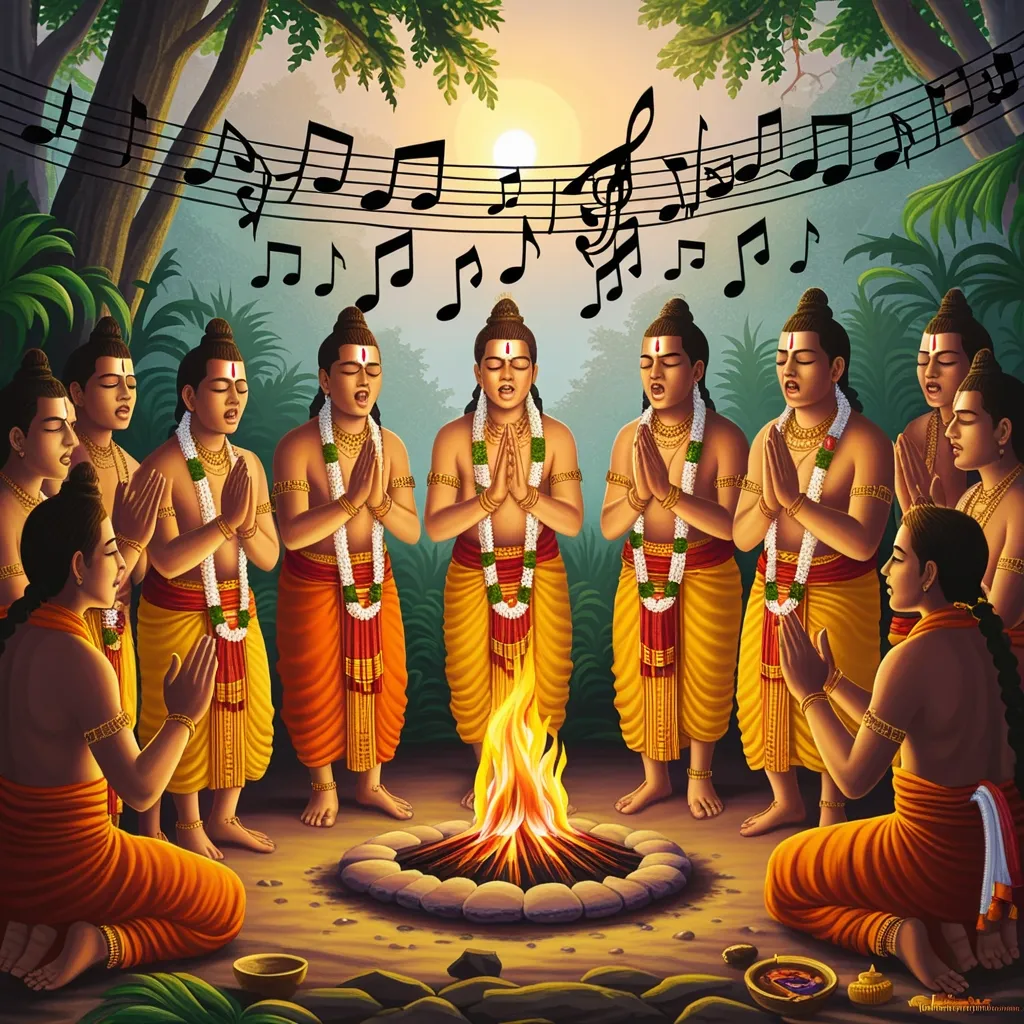
The Vedic practice most associated with Ushas is the Agnihotra, a fire offering performed twice daily at sunrise and sunset. The householder rose before the light appeared, purified themselves with water, and kindled a small sacred fire. Specific materials were offered with specific sounds. The ritual was not a transaction, not a bargain made with the divine. It was a recognition. An acknowledgment that the order bringing light each morning is real, that it matters, and that the human being chooses to align with it rather than ignore it.
This is a subtle but significant distinction. Prayer as transaction says, give me something. Ritual as recognition says, I see what is already happening, and I choose to be part of it. The first posture is need. The second is participation. Most spiritual maturity moves in that direction, from asking to noticing.
Ushas herself embodies something that does not get enough attention in spiritual writing: constancy without judgment. She appears every day. She does not take days off because you behaved badly yesterday. She does not withhold her light because you failed, quarreled, wasted time, or felt resentful. She comes anyway. Reliably. Without commentary.
“Every day is a new beginning. Treat it that way. Stay away from what might have been and look at what can be.” — Marsha Petrie Sue
That kind of unconditional return is a teaching in itself. The dawn does not ask whether you deserve it. The question it places before you, quietly and without pressure, is simply: what will you do with this one?
The Upanishads, which grew from the same root as the Vedic hymns, take the metaphor inward. They describe a light that is not the sun, not fire, not any external source. They call it the light of the self, the awareness that makes all other experience possible. You cannot see this light the way you see a lamp because it is the seeing itself. Ushas, understood symbolically, becomes a pointer toward that inner reality. The outer dawn mirrors an inner one.
What would an inner dawn even feel like? Think of a moment when something clicked after long confusion. When grief suddenly softened. When a problem you had been grinding against for weeks dissolved in a single clear thought. That is closer to it than any formal definition.
What darkness have you been sitting in so long that you have started to mistake it for the natural state of things?
The Vedic tradition would say that mistaking darkness for permanence is the fundamental error. Not sin, not moral failure, but a mistake in perception. The Sanskrit word for this is avidya, which translates roughly as not-knowing or ignorance. It is not stupidity. It is simply not yet having seen the light that was there all along.
“The sun does not wait for the world to be ready. It rises.” — Anonymous
Ushas does not wait for ideal conditions either. She rises into fog, into cloud cover, into days that will turn cold and grey. The light comes regardless. The Vedic seers found this comforting rather than indifferent. Consistency at that scale is a kind of love.
Practically speaking, the invitation here is not to build a fire altar in your backyard (although, honestly, that is your choice). The simpler version is to create a few minutes of intentional stillness at the boundary between night and morning. Rise early enough to catch the shift. Go outside if you can. Face east. Watch the colours change from black to navy to grey to gold. Breathe deliberately. Say nothing, or say thank you, depending on what feels right.
You are not performing a ritual for Ushas. You are training your own attention. You are teaching your nervous system that the day begins with quiet rather than urgency. Over weeks and months, this practice reshapes the way a day feels from the inside.
“Lose an hour in the morning and you will be looking for it all day.” — Richard Whately
Ancient Indian scholars noted that the mind at dawn, the period called Brahma Muhurta, the hour of Brahma, occurring roughly ninety minutes before sunrise, is unusually receptive. Not foggy with sleep, not yet cluttered with the day’s demands. Meditation, memorization, and contemplation were consistently placed in this window. Not as a rule but as an observation. The mind is clearer then. Something about the transition from sleep seems to make the inner sky more open.
Modern sleep science, without knowing anything about Vedic literature, has arrived at something adjacent. The hypnopompic state, the period of transition between sleep and waking, produces unusual cognitive clarity and creative insight. The brain during this window is in a theta-wave state, associated with intuition, imagination, and receptivity. The seers did not have electrodes or terminology. They had observation, and their observation was accurate.
What is less known about Ushas is her relationship to speech. In the Rigveda, she is directly linked to vac, the sacred word, the divine speech that underlies all sound and meaning. Before she rises, the world is silent. Her arrival makes the world speakable again. Birds begin. People stir. Language returns. She is, in this reading, not just the goddess of light but of communication, of articulation, of the moment when the inner world finds its outer expression.
This is why poets have always loved the dawn. Not just because it is beautiful (it is), but because something about it opens the mouth and the mind in the same motion.
“Dawn: when men of reason go to bed.” — Ambrose Bierce
(Even the cynics knew it was a significant moment.)
The real gift of Ushas, taken as a living principle rather than a mythological figure, is that she makes beginning again feel possible. This is not a small thing. The weight of accumulated failure, of habits that have not changed, of the self-image that says you are simply this way and always will be, is genuinely heavy. The dawn arrives and offers something different. Not a sermon. Not a demand. Just light. Just the fact that the world has continued and you are in it and something new is technically possible now.
That is hope in its most honest and undramatic form. Not the inspirational-poster version. The quiet, daily, persistent kind that does not need your belief to function. The sun rises whether you believe in it or not. The question is only whether you notice.
Go outside tomorrow morning before you check your phone. Even for five minutes. Watch what the sky does. Watch what happens inside you when you do. Then decide whether the seers who sang to Ushas three thousand years ago were wasting their time or had found something worth keeping.