Rta: The Ancient Vedic Law That Governs Reality, Ethics, and Everything You Do
Discover Rta, the Vedic principle of cosmic order that governed ethics before gods existed. Learn how truth, duty, and daily choices align — or conflict — with reality itself.

There is a concept in the oldest literature humanity has ever produced that makes the gods themselves look like latecomers. It does not have a throne, a mythology, or a personality. It does not ask for prayers or offerings. It simply is, operating beneath everything we see, hear, and experience. The ancient Vedic seers called it Rta, and once you understand it, you will never look at a sunrise, a broken promise, or a moral choice the same way again.
Think of Rta as the universe’s internal operating system. The sun rises every morning not because some divine authority flips a switch but because existence itself follows a pattern. Rivers reach the ocean. Seasons rotate with clockwork precision. Your heart beats in rhythm. None of this is accidental. The Vedic sages saw these patterns not as cold, mechanical facts but as evidence of a living, breathing intelligence woven into the structure of reality. They called this intelligence Rta.
What separates this idea from a simple observation about nature is what it demands of us.
You see, rocks and rivers follow Rta automatically. They have no choice. The moon does not decide to wax and wane. It just does. But human beings are an unusual case. We carry something rare in this universe — the ability to choose. We can act in tune with the underlying order, or we can work against it. That freedom is exactly where Vedic ethics begins.
“Truth is one; the sages call it by many names.” — Rig Veda
Every honest conversation you have, every duty you fulfill, every act of genuine generosity — these are not just socially approved behaviors. According to Rta, they are expressions of alignment with what is fundamentally real. And every lie, every act of exploitation, every deliberate cruelty — these are not just moral failures. They are distortions, friction introduced into the fabric of existence. The friction does not go unnoticed. It produces consequences.
Here is a question worth sitting with: Have you ever noticed how a single lie tends to demand more lies to survive? How one broken promise usually fractures a relationship in ways that take far longer to repair than the moment of breaking? That is not coincidence. That is Rta doing what it does — pushing back against disorder.
The Vedic concept of Satya, which we often translate simply as truth, runs parallel to Rta and is inseparable from it. Satya is not just about stating accurate facts. It means existing in accord with what is real. A truthful word, spoken with full awareness, carries the weight of the cosmic order behind it. The Vedic hymns describe truth as the axle that holds the chariot of the worlds together. Remove the axle, and everything falls apart. That is not poetry for poetry’s sake. It is a precise description of how reality operates.
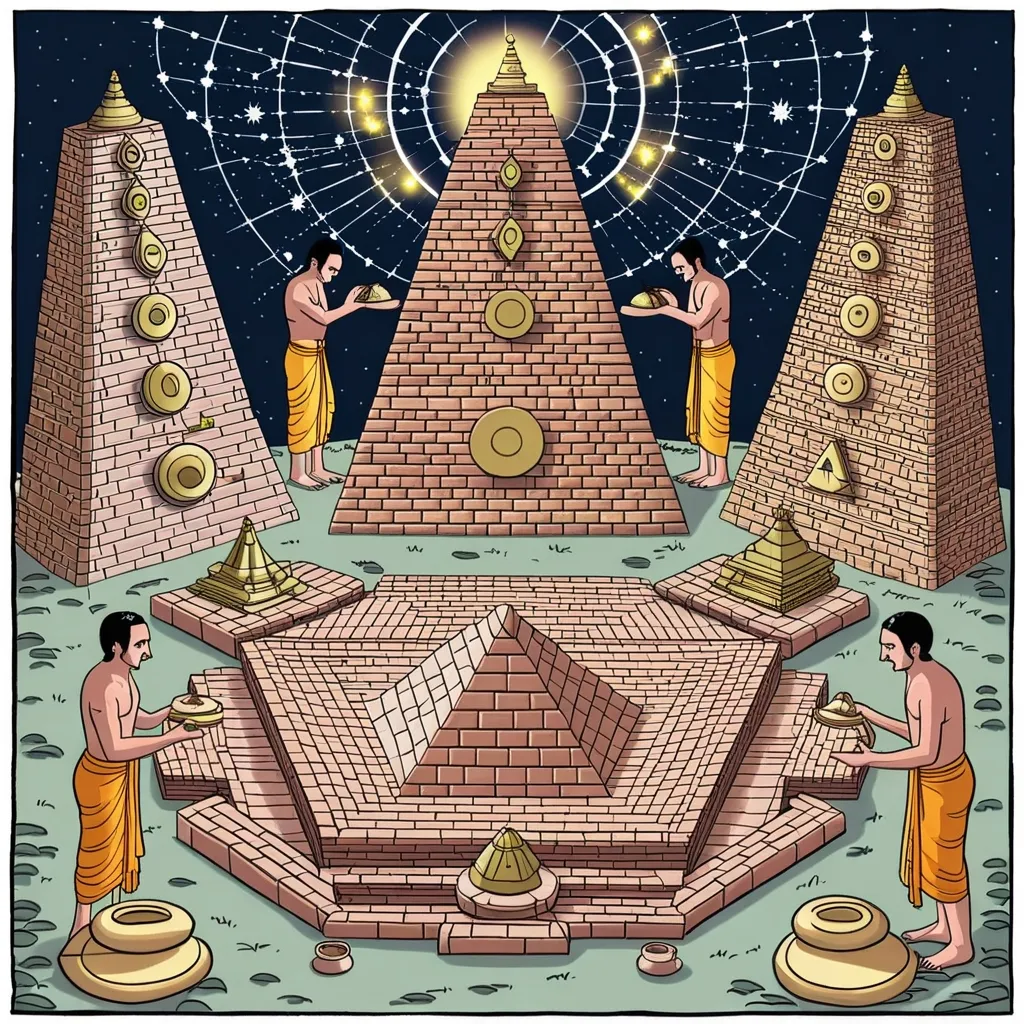
What most people do not know is that Vedic ritual — the fire sacrifices, the precise chanting, the geometrically exact altar construction — was not superstition or bribery aimed at placable gods. Each ritual was understood as an act of cosmic maintenance. A priest who performed a sacrifice correctly was doing what a mechanic does when tuning an engine. Every precisely uttered syllable was a small vote for order over chaos. The belief was not that the ritual created Rta but that it reinforced it, kept it humming at the human level.
This raises a genuinely uncomfortable idea. If human conduct has a hand in maintaining cosmic order, then every person carries a responsibility that extends far beyond their personal life. The unjust ruler does not only harm his subjects. He introduces imbalance at a structural level. The householder who refuses hospitality does not simply appear rude. He tears at a thread in the web that holds society — and by extension, reality — together. Vedic ethics is not private. It is public in the deepest sense imaginable.
“The whole secret of existence is to have no fear.” — Swami Vivekananda
The opposite of Rta is called Anrita — disorder, falsehood, the deviation from the true pattern. What makes Anrita fascinating is that the suffering it produces is not a punishment handed down by an angry deity. There is no celestial judge reviewing your case. The suffering is simply what happens when you act against the grain of existence. A community that normalizes dishonesty does not get struck by lightning. It decays quietly from within, losing its capacity to function. A person who habitually deceives does not get cursed. They gradually lose the ability to perceive things clearly. The correction is built in. The system seeks its own balance.
Ask yourself this: Do you think of ethics as a list of rules someone imposed on you, or do you think of it as a description of how things actually work?
That distinction is everything. When ethics is just a list of imposed rules, you follow them only when someone is watching. When ethics is understood as a map of reality, you follow them because violating them is simply impractical. Kindness, discipline, and honesty are not noble performances. They are intelligent responses to the actual structure of the universe. They work because they are in tune with something real.
Practical alignment with Rta does not require initiation into ancient philosophy. It starts with paying attention. Notice the rhythms of your own body. Your energy rises and falls at predictable times. Your mind is clearer at certain hours. Your relationships operate in cycles. When you eat food that is seasonally available, sleep when it grows dark, and speak with deliberate care, you are already moving in closer agreement with the underlying order. When you override your body’s signals with stimulants, eat whatever is convenient at whatever hour, and speak carelessly because you are in a rush, you create friction — not metaphorical friction, but actual dissonance in your biology, your relationships, and your thinking.
“In the attitude of silence the soul finds the path in a clearer light.” — Mahatma Gandhi
The ancient seers who first articulated Rta were not satisfied with simply describing the pattern. They wanted to know where it came from. Their investigation led them to a conclusion that still strikes as genuinely radical: Rta itself rests on something deeper, an unborn, nameless ground from which all laws and all order emerge. They suggested that a person who reaches direct knowledge of that ground no longer needs to work at alignment because they have become, in some sense, one with the source of the pattern itself.
That is an advanced destination. For most of us, the practical path is simpler and more immediate. Watch the order that already exists in your life — in your breath, in the relationships that sustain you, in the work that actually fulfills you. Notice where you are fighting against a rhythm rather than moving with it. Make small corrections. Speak more carefully. Rest when rest is required. Act from what you know to be true rather than from what is merely convenient.
The real insight Rta offers is not mystical. It is deeply pragmatic. The universe is not indifferent to how you live. It has a structure, and that structure has preferences — not personal preferences, not the whims of a temperamental god, but the preferences built into reality itself. Truth is preferred over falsehood because falsehood is structurally unstable. Order is preferred over chaos because chaos, left unchecked, destroys the conditions necessary for anything to exist at all.
Living in alignment is not about being perfect or philosophically sophisticated. It is about choosing, moment by moment, to act in ways that are consistent with what you know to be real. That is the entire teaching. And it was articulated thousands of years ago by people sitting beside fire, watching stars move across an unchanged sky, realizing that the pattern above them and the pattern within them were the same thing.
The thread is still there. You just have to be willing to follow it.