The Hidden Threads That Bind Everything: Understanding Vedic Interconnectedness
I want to talk about something that changed how people understood reality thousands of years ago, and it’s still relevant today. The ancient Vedic thinkers discovered that nothing in this universe stands alone. Everything connects to everything else through invisible threads. This wasn’t philosophy for its own sake—it was a practical guide for living that influenced how people approached rituals, ethics, health, and ultimately, their entire relationship with existence itself.
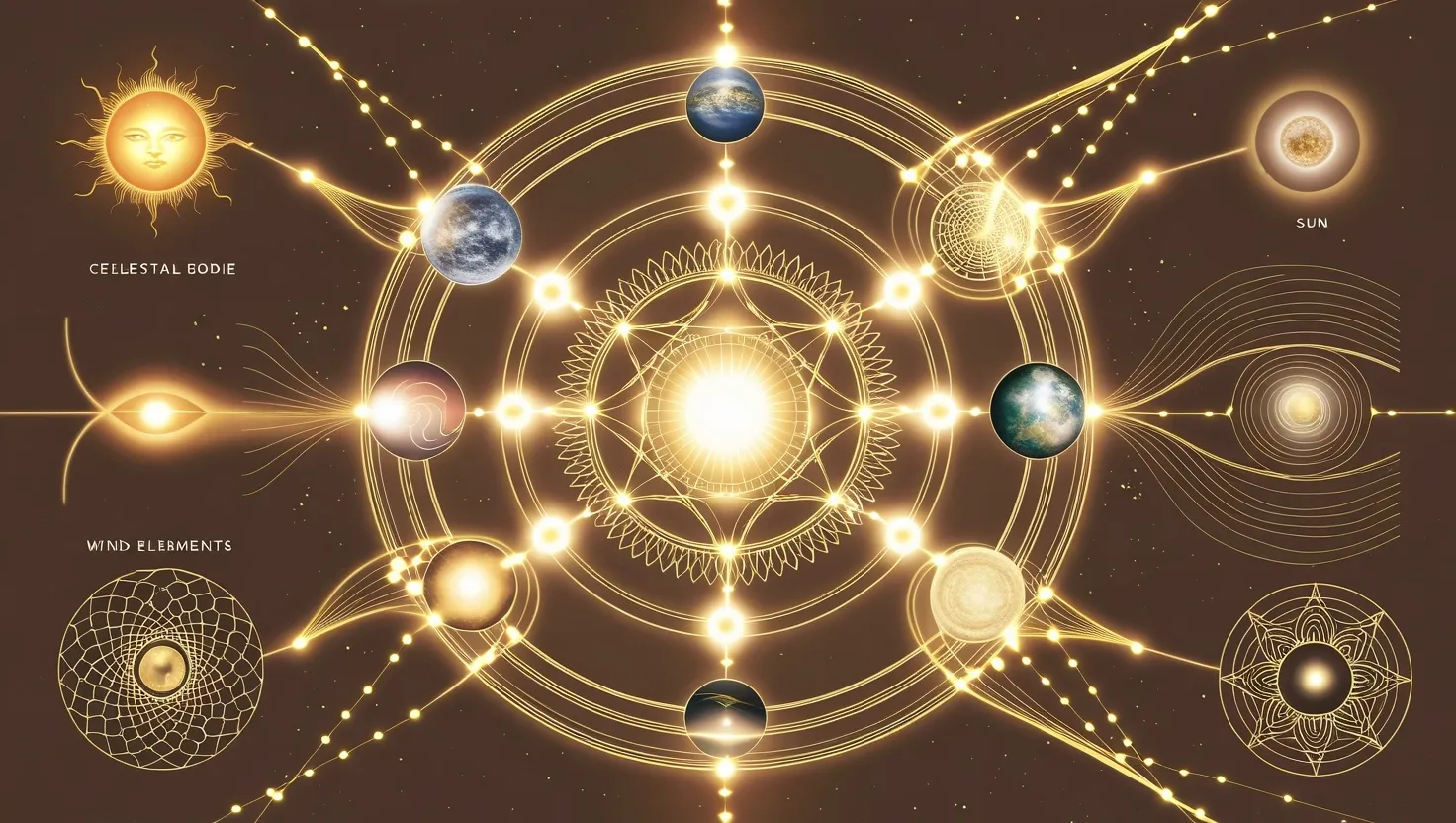
Let me start with the most basic question: have you ever wondered why the sun in the sky and the eye in your body seem to work the same way? Or why the wind moves like the breath of a living creature? The Vedic scholars noticed these patterns everywhere, and they called this phenomenon bandhu. The word translates as “connection” or “link,” but it means so much more. It’s the principle that cosmic forces and human existence are bound together through precise correspondences. When you understand bandhu, you stop seeing the universe as random atoms bumping into each other. Instead, you recognize it as an intelligible whole where patterns repeat at every scale.
This isn’t mystical thinking—it’s observational. The early Vedic thinkers looked at the world without modern instruments and noticed something profound: the same patterns appear in the sky as in the body, in the atom as in the galaxy. Before physics gave us a name for it, they recognized what we now call fractal geometry and universal principles. They saw that knowledge wasn’t about collecting isolated facts. True knowledge meant grasping how everything relates to everything else.
The Rigveda, one of humanity’s oldest texts, expresses this clearly. When it says the sun is the eye of the cosmic being, or that fire represents the digestive power in both the universe and the human stomach, these weren’t poetic flourishes. They were statements of actual correspondence. The scholar understood that by studying one thing deeply, you gained insight into its counterpart. The microcosm reflected the macrocosm. A drop of water contained the essential nature of the ocean.
Consider what this meant practically. If the sun corresponds to the eye, then understanding how light works teaches you about perception itself. If the wind is the cosmic breath, then studying atmospheric patterns reveals something about respiration and life force. This isn’t superstition—it’s recognizing that nature operates according to repeating principles. Modern systems theory and ecology have arrived at similar conclusions through different methods. We now understand that an ecosystem functions as an interconnected web, just as the Vedic thinkers described existence itself.
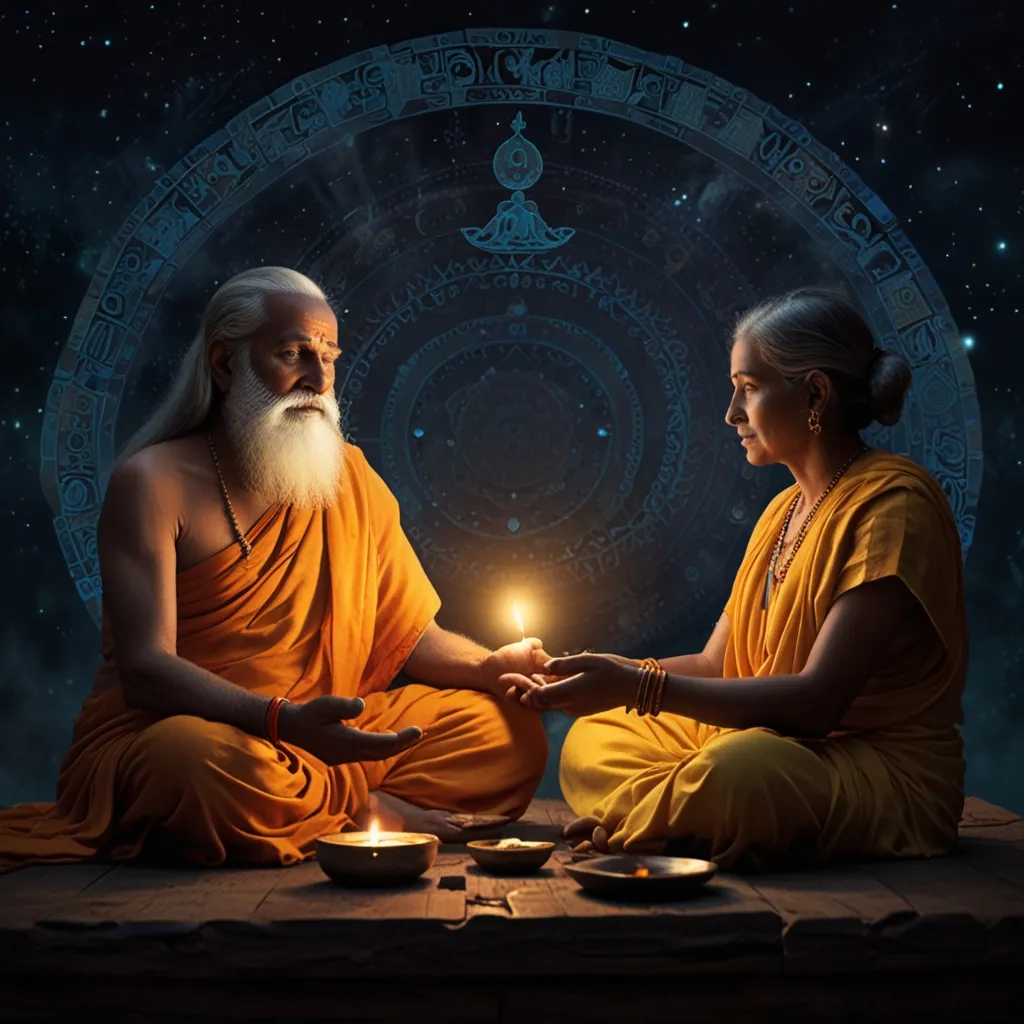
The ritual context makes this even clearer. When someone performed a yajna, or sacred ritual, they weren’t engaging in arbitrary actions. Every element corresponded to cosmic forces. The fire altar wasn’t just symbolic—it was a miniature universe. The wood burned represented the elements. The smoke carried offerings to the devas, or natural forces. The mantra, or sacred sound, wasn’t decoration. It was considered the vibrational structure of a natural law. When chanted with understanding, it aligned the participant’s consciousness with universal patterns. The ritual became a practical technology for attuning oneself to reality’s deeper structure.
Here’s what’s interesting: the ritual worked not through magic but through attention. By understanding the connections between each element and its cosmic counterpart, the performer became consciously aware of participating in a universal exchange. They weren’t separate from nature, commanding it from outside. They were participants in an ongoing cosmic dance. Modern psychology recognizes something similar—when you act with genuine understanding of how your behavior affects a larger system, your actions carry different power and intention than when you act mechanistically.
Think about how this changes ethics. If all parts of existence are bound together through bandhu, then hurting one part affects the whole system. This is exactly what we now call systems thinking. An ancient saying expresses this beautifully: “Vasudhaiva Kutumbakam,” meaning the world is one family. This wasn’t abstract idealism. It flowed directly from recognizing that we’re all connected through fundamental links. Exploitation of the environment isn’t profitable in the long run—it’s self-injury. Dishonesty doesn’t just violate rules; it disrupts the truth that binds the cosmos together. Every unethical action creates ripples through the web of connection.
When I examine how health was understood in this framework, I see something that modern medicine is only recently rediscovering. The body wasn’t viewed as a machine with replaceable parts. It was a network of relationships. Health meant these relationships were functioning in harmony—proper balance between the body’s elements, smooth communication between senses and mind, alignment between the person and their environment. Disease wasn’t just a malfunction of one part. It represented a breakdown in these connections. Healing meant restoring proper relationship. That’s why traditional Ayurvedic medicine considers diet, lifestyle, seasonal rhythms, emotional state, and community all as factors in treatment. It treats the person as embedded in networks rather than as an isolated body.
Here’s a profound realization from contemplating bandhu: at the deepest level, recognizing all these connections leads to a complete transformation of identity. The seeker stops experiencing themselves as a separate entity connected to other separate entities. Instead, they recognize that separation itself is illusory. The individual wave realizes it isn’t separate from the ocean—it is the ocean taking a particular form. This is the ultimate teaching within Vedic philosophy. It’s not just intellectual understanding that we’re all connected. It’s direct experiential knowledge that we’re all expressions of a single reality playing out through infinite forms.
I want to emphasize something crucial here: this philosophy offers something our modern world desperately needs. We live increasingly isolated lives, physically and psychologically separated from nature. We experience loneliness despite being surrounded by people. We treat the earth as a resource to exploit rather than a living system of which we’re part. The Vedic understanding of bandhu provides a different foundation. It suggests we belong to something larger and more meaningful than our individual concerns. By recognizing the threads connecting us to everything else, we recover a sense of participation in a purposeful whole.
What does this look like in practice today? It means pausing to recognize connections you normally overlook. Your breath connects you to the air, the trees, the sky. Your body connects you to the earth through food, minerals, and elements. Your thoughts connect you to cultural traditions stretching back centuries. Your actions ripple through social and ecological systems in ways you can’t fully predict. When you genuinely feel these connections rather than just believe them intellectually, something shifts. Decisions change because you recognize consequences reaching further than you previously acknowledged.
The Vedic rishis arrived at this understanding without microscopes or telescopes. They did it through patient observation and contemplative practice. They recognized that the universe operates according to intelligible patterns available to human understanding. This is profoundly hopeful. It means that by studying one domain deeply—whether the stars, the body, or social relationships—you gain insight into the nature of all domains. The patterns repeat. The principles translate across different scales and contexts.
Modern physics, ecology, and systems theory increasingly validate what the Vedic thinkers understood. Particles separated by vast distances influence each other instantaneously. Remove one species from an ecosystem and cascading effects ripple through the entire network. Change one variable in a complex system and unexpected consequences emerge everywhere. These discoveries align with the ancient insight that everything connects to everything else through precise correspondences.
The philosophy of bandhu also reframes how we think about knowledge and learning. Rather than accumulating isolated facts, true learning means grasping relationships. It means seeing patterns. It means understanding how studying one thing illuminates understanding of something seemingly unrelated. Education becomes less about memorization and more about developing perception of deep connections.
What the Vedic philosophers understood is that reality isn’t fragmented. It’s not a collection of separate things that happen to interact. It’s a unified whole expressing itself through infinite diversity. The connections between parts aren’t added on top of reality—they’re fundamental to reality’s nature. We perceive separation only because our ordinary consciousness is limited. But deeper investigation reveals that separation is superficial while connection is fundamental.
This teaching invites a question we should each ask ourselves: what changes when I genuinely recognize that I’m not separate from the world around me? Not as a poetic idea, but as lived reality? How would my choices shift? How would my relationships transform? What would I value differently? The Vedic philosophy of bandhu suggests that asking these questions and pursuing genuine answers leads toward wisdom, wellbeing, and participation in something infinitely larger than individual concerns.
The ancient Vedic vision created a map of reality where everything makes sense in relation to everything else. This map still works. It offers a corrective to the fragmentation and alienation of modern life. By learning to see the threads of connection that bind all existence, we recover our place in a meaningful, intelligent, and deeply interconnected whole.