Ancient Vedic Medicine: What the Rigveda Really Teaches Us About Healing the Whole Person
Discover how the Rigveda's ancient philosophy of medicine treats the whole person — mind, body, and community. Explore Vedic healing and what it means for you today.
Most of us know the Rigveda as a book of hymns about fire, dawn, and the mystery of creation. But buried inside these ancient Sanskrit verses is something far more surprising — a complete philosophy of medicine. Not pills. Not prescriptions. A living, breathing system that treats the sick person as a whole human being tangled up in a web of relationships, seasons, and sounds.
Let me walk you through it simply.
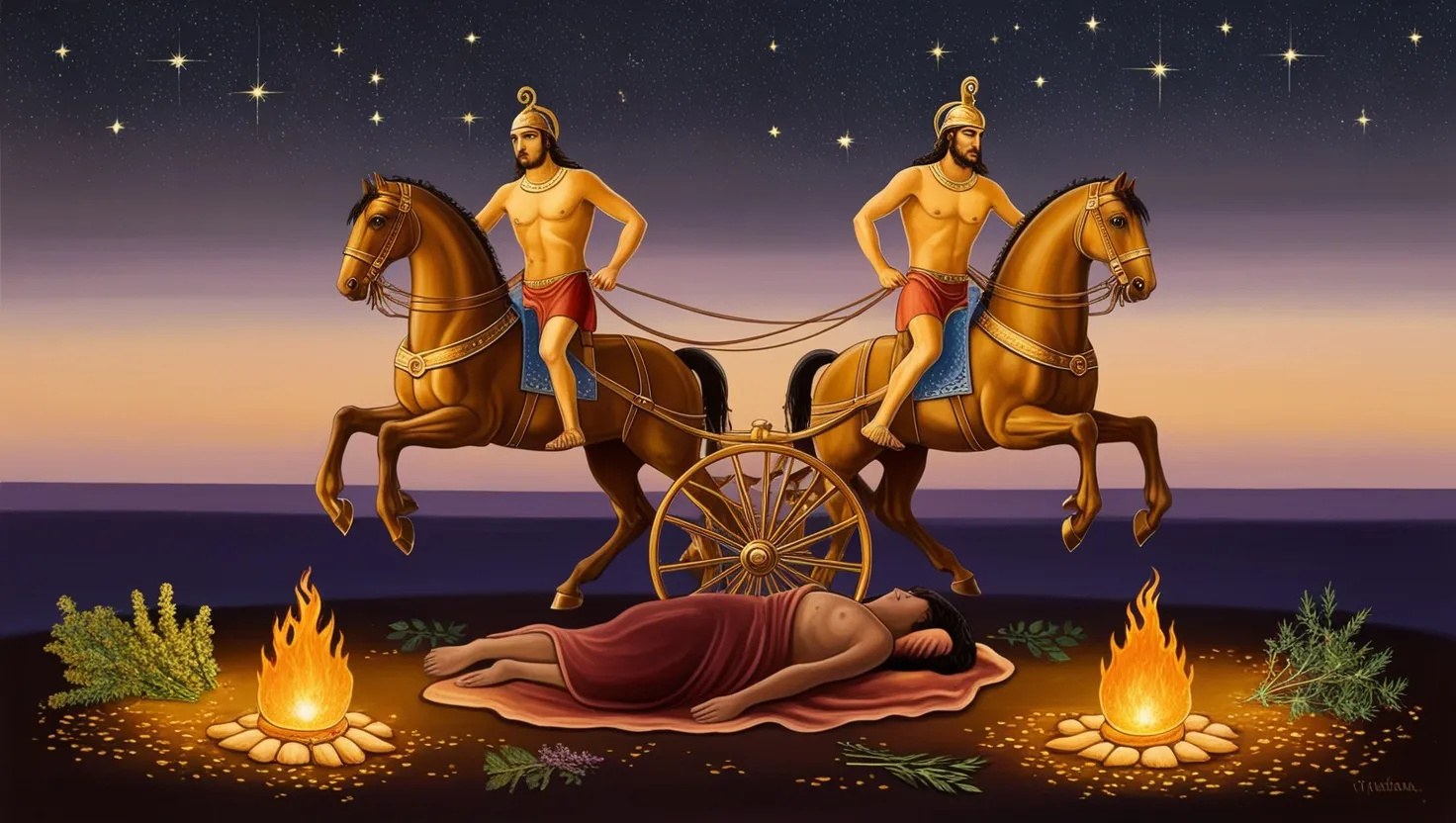
The Rigveda is one of the oldest texts ever written. Thousands of years old. And right there inside it, among its oldest prayers, you find two divine figures called the Ashvins. Twin horsemen. Brothers who ride a chariot across the sky just before sunrise. They are described as the physicians of the gods themselves.
Think about that for a second. Even the gods needed doctors.
The Ashvins are not slow, thoughtful healers sitting in a quiet room. They are fast. Their chariot is swift because, as the Rigveda puts it, suffering cannot wait. They restore sight to the blind, give strength back to the lame, and return youth to those worn down by age and illness. They show up at dawn because dawn itself represents a second chance — the world starting over after darkness.
“The physician who knows no other remedy than the knife is a poor physician.” — Voltaire
Here is where the Vedic view of healing gets genuinely interesting, and where it parts ways with almost everything we take for granted in modern medicine.
When someone fell ill in Vedic times, the healer’s first question was not what is broken? The first question was what has been lost? Because in this tradition, disease is not simply a foreign enemy that sneaks into your body. It is a rupture — a break in the natural rhythm connecting you to your breath, your seasons, your community, and your sense of purpose. Healing, then, is not war against a symptom. It is the restoration of a whole.
This is a completely different starting point.
Have you ever considered that your body might be trying to tell you something your mind refuses to hear? The Vedic tradition believed exactly this.
Mantra — sacred sound — sat at the centre of Vedic medicine. A hymn recited with clear intention was understood to steady the mind and move what the tradition called the “subtle body,” an invisible layer of energy running through and around the physical form. The Rigveda contains verses that address healing plants directly, calling them mothers. These verses ask the plants to release the patient from suffering the way a calf is released from a tether. Gently. With care.
The plant is not treated as a chemical compound. It is treated as a presence. Something gathered with prayer and offered with respect. The preparation of medicine was itself a ritual act.
Water was treated the same way. Before being drunk or poured over the body, water was charged with mantra. The patient would sit near fire. The family gathered. The priest would speak words that named the illness aloud and commanded it to leave. This was not fantasy or wishful thinking. It was a structured practice of bringing order against disorder — aligning human intention with what the tradition called rta, the cosmic law holding the universe in balance.
“The art of medicine consists in amusing the patient while nature cures the disease.” — Voltaire
There is a figure in the Rigveda who appears in a way that should make us stop and think. His name is Rudra. He is the god who carries the arrow of disease. And he is also the god who carries the healing herb. The same hand that wounds also cures.
This paradox is not accidental. The Vedic tradition taught that health and illness are not permanent enemies. They are two movements inside a larger field of life. A healer who does not respect the power of illness will be defeated by it. A patient who refuses to face their own fragility cannot fully recover.
The Ashvins being described as young is a detail most people overlook, but it carries real meaning. Healing is not just the repair of old damage. It is the return of freshness. Every recovery is a small rebirth. The twin physicians always arrive together because health itself is a balance between opposites — rest and movement, heat and cold, giving and receiving, self and world.
Practical Vedic healing was deeply specific about daily life. It asked how a person slept, what they ate, how they spoke, and whom they served. Breath was observed carefully. Posture was corrected. Food was received as an offering before being eaten. Speech was treated as medicine or poison — harsh words were understood to injure the body as surely as bad air.
The healer was, all at once, a physician, a teacher, and a priest.
“To keep the body in good health is a duty, otherwise we shall not be able to keep our mind strong and clear.” — Buddha
Ayurveda, the classical Indian medical system that developed centuries after the Rigveda, inherited every one of these ideas. It organized them into detailed categories of energies and elements, body types and seasonal rhythms. But its root stayed Vedic. The body is a small version of the universe. The mind is not separate from the tissue. The community is not separate from the patient. Cure one person and you mend something in the whole group. Neglect the sick and you damage the health of everyone around them.
Modern medical care tends to do the opposite of this. One specialist treats the heart. Another treats the mind. Another looks at the family situation, if anyone does at all. The Vedic physician refused that division from the very start. Before asking where something hurts, a Vedic healer would ask what kind of life is being lived. That answer shaped everything that followed.
A medicine that ignores the patient’s story is only half a medicine.
There is also a hard truth embedded in this tradition — one that is easy to miss. Not every illness leads to recovery. The Ashvins restore many people across the hymns, but death remains what the tradition implicitly calls the final physician. Vedic culture did not turn away from this. The healer was expected to accompany the dying as faithfully as the recovering. When the body could no longer hold, the deeper self was understood to remain whole. The ultimate form of healing, in this view, is the patient’s own recognition of that wholeness.
What can you actually take from all of this and use today?
Start the morning with water and light. Breathe with intention for three minutes before reaching for a screen. Offer your food a moment of gratitude before eating it. Speak one honest, kind word before saying anything else. When illness arrives — and it will — resist the urge to immediately suppress it. Ask, first, what imbalance has appeared. Ask what relationship might need attention. Then ask for help. Let people serve you. Healing has never been a private achievement.
“The greatest medicine of all is to teach people how not to need it.” — Hippocrates
The Ashvins still ride at dawn, in a sense. They appear every time skill and genuine care meet in the same moment. They are present in the nurse who stays an hour longer than required, the doctor who asks how your life is going before asking where it hurts, the neighbor who brings food, the patient who chooses to forgive rather than stay bitter.
The Rigveda does not draw a line between medicine and prayer. It teaches that to heal a person is to restore them to the whole — and that restoring the whole is the oldest and most sacred work there is.