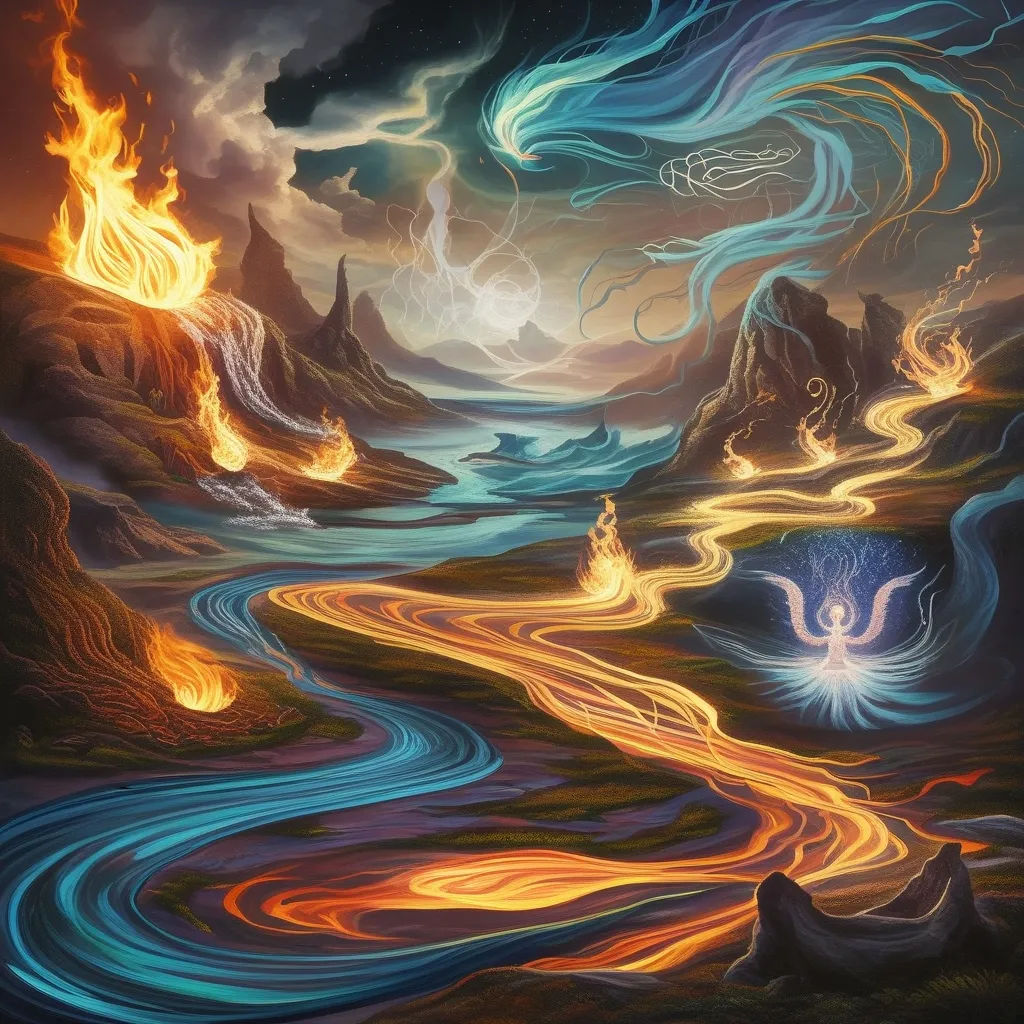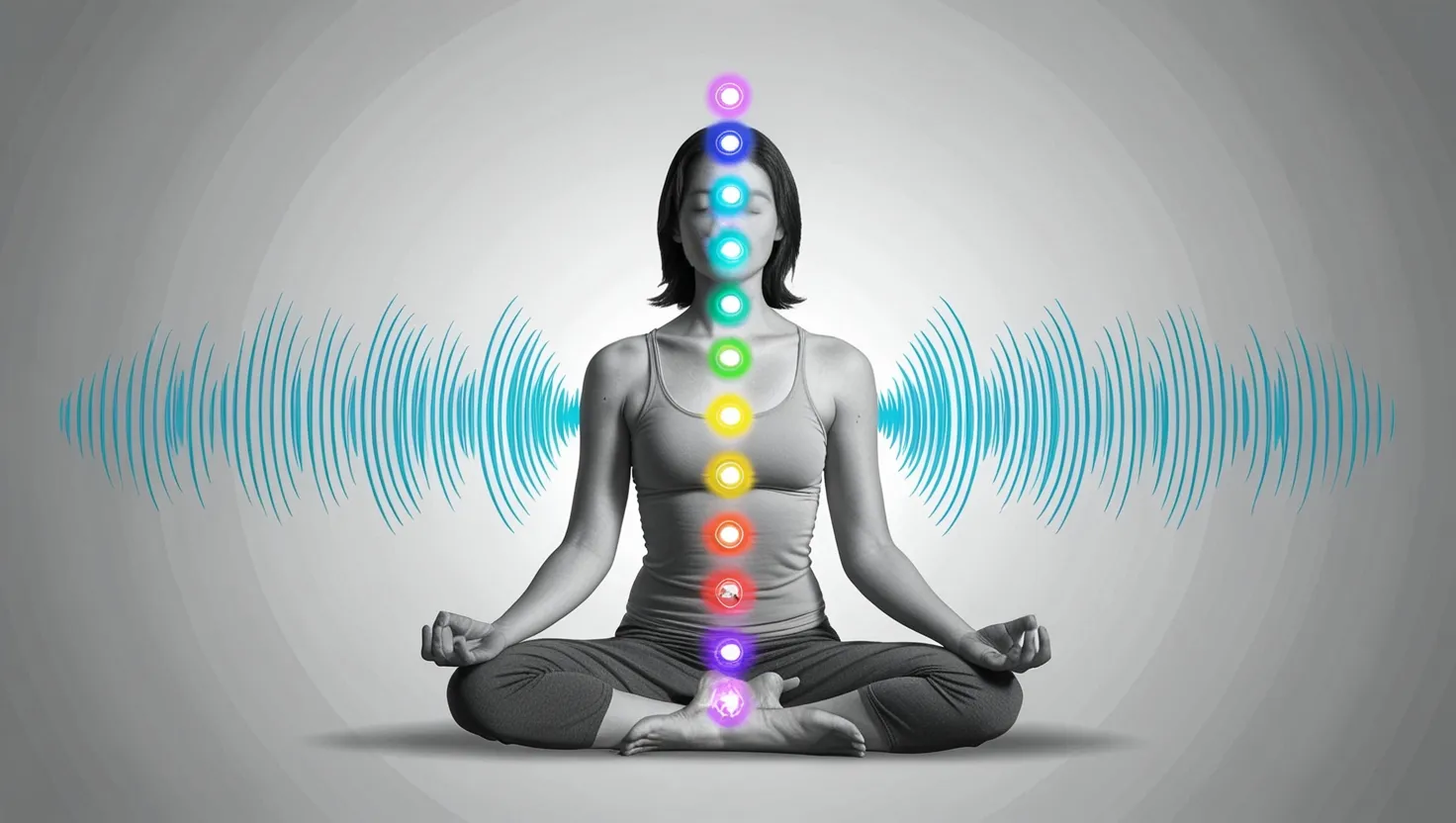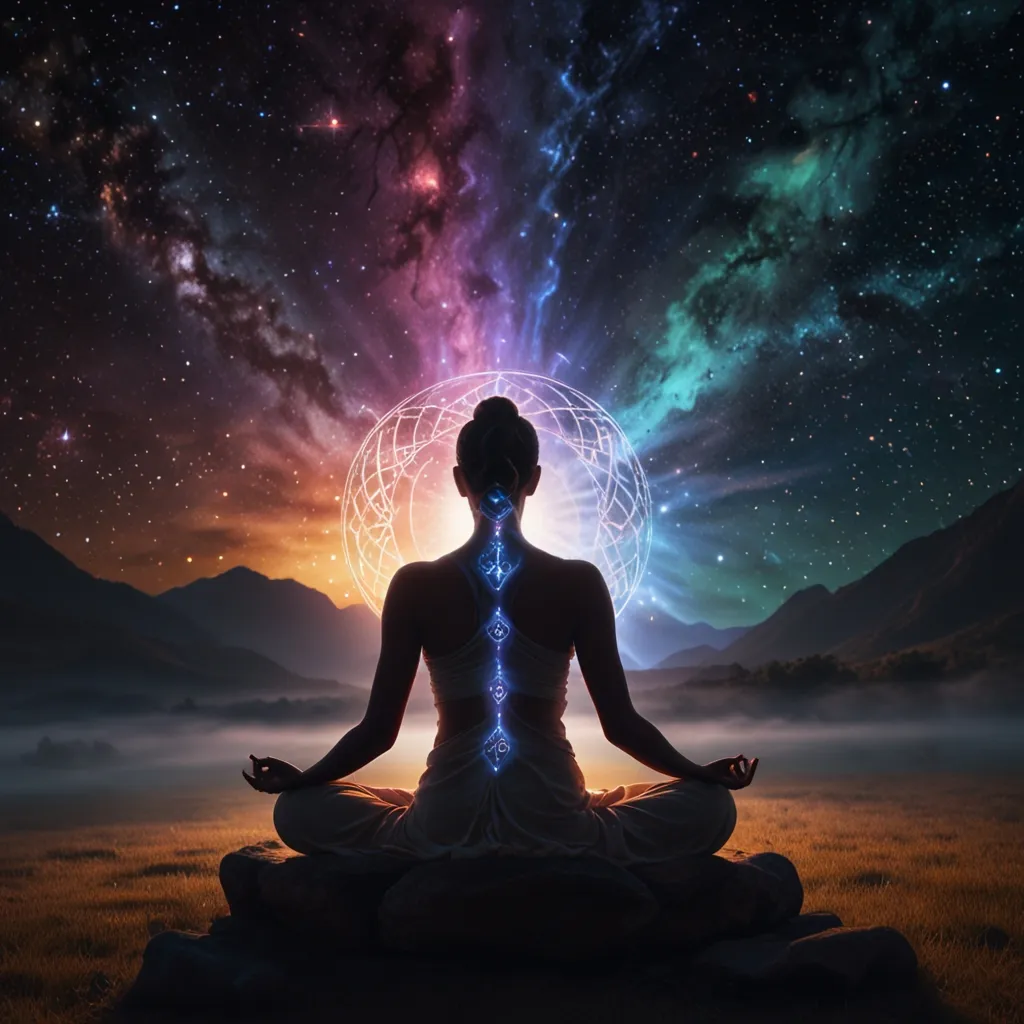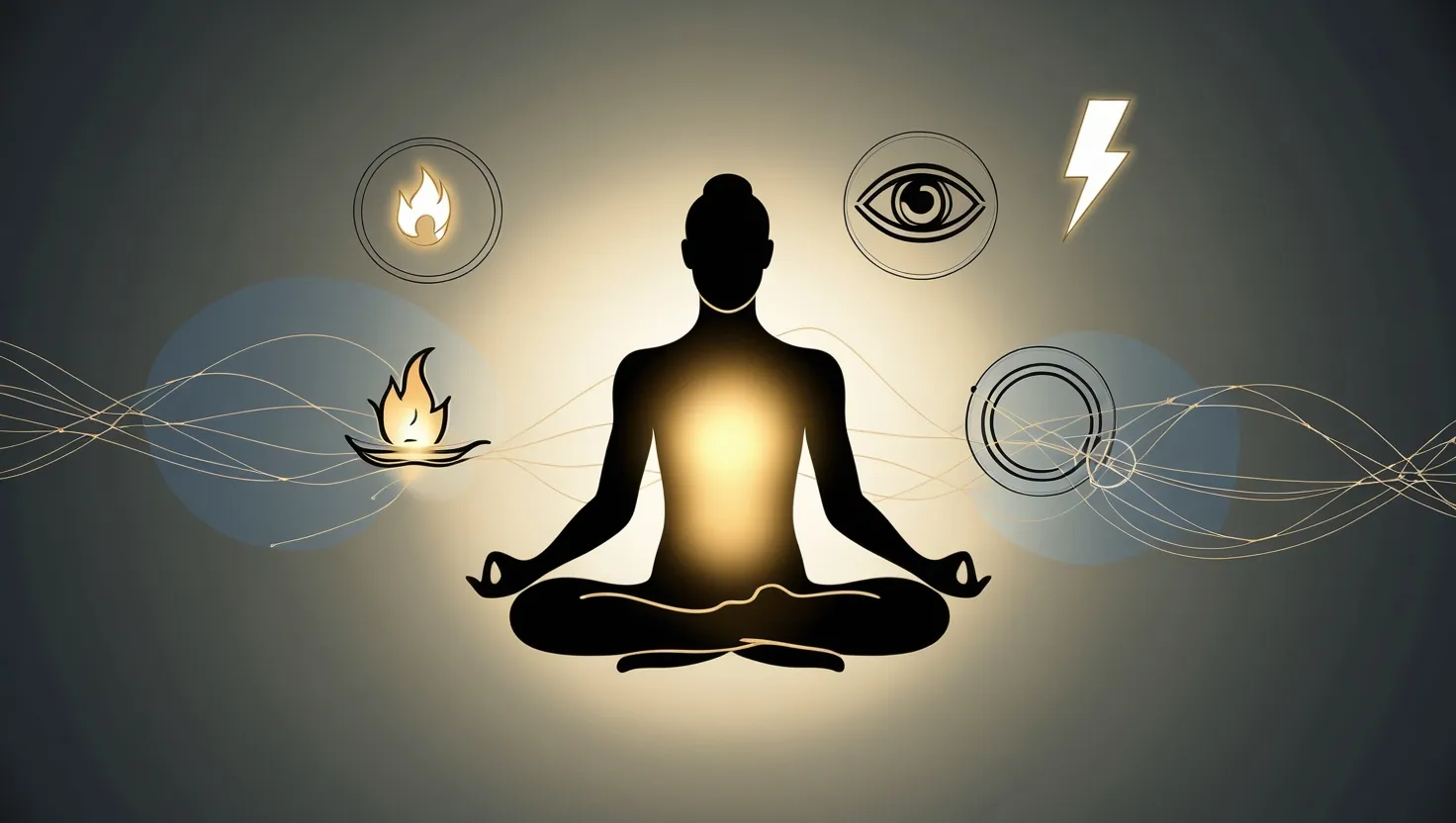
When most people hear “Vedic gods,” they picture many arms, weapons, and strange myths. I want you to forget that picture for a moment. Think of them instead as parts of your own mind, given faces and stories so even a child could understand how consciousness works. That is what the Vedic seers were doing: turning psychology into stories so the nervous system could learn through images, not just ideas.
Let me say it very simply: the Vedic deities are like apps running inside your consciousness. Each god is a special function. Fire is not just fire; it is how you digest food, experience, and even pain. The sun is not just a ball of gas; it is your attention. The sky is not just empty space; it is the silent background of awareness in which every thought appears.
You might ask, “Why bother giving them names? Why not just say ‘attention,’ ‘memory,’ ‘will’ and keep it scientific?” Because the ancient teachers understood something that modern psychology sometimes forgets: the mind responds faster to a story than to a theory. When you picture a god fighting a dragon, your nervous system remembers that struggle much more deeply than if I present a diagram of “ego versus unconscious resistance.”
Let’s start with Agni, the fire. In rituals, he is the visible flame. In your life, he is the process that turns “raw stuff” into “usable energy.” When you eat, your body’s fire breaks food into nutrients. When you study, your mental fire breaks information into understanding. When you suffer, the same inner fire can burn confusion into wisdom, if you let it.
Can you notice this in yourself? Think of a difficult event in your past. At first it was just pain. Then, slowly, you made sense of it. That “making sense” is Agni at work inside your mind. When Agni is weak, you feel dull and heavy. Information goes in, nothing transforms. You scroll endlessly, you consume, but you do not digest. When Agni is strong, you can take even failure and turn it into clarity.
“Out of suffering have emerged the strongest souls; the most massive characters are seared with scars.”
— Khalil Gibran
I want you to see that Gibran’s “searing” is exactly what the Vedic fire is about: heat that changes you. If you treat pain only as something to escape, you put out your own fire. If you treat pain as “fuel,” you honor Agni. This is not a fancy belief. It is a very practical inner skill: can I digest what happens to me?
Next, look at Indra, the leader of the gods. In the sky, he throws thunderbolts and breaks the cloud-demon to release rain. In your mind, he is focused will, the “I” that decides and acts. His famous enemy, the serpent Vritra, is not just a monster. It is the tight, coiled resistance inside you: laziness, fear, frozen habits.
Have you ever felt that you know what to do, but you just cannot do it? That is Vritra in psychological language. The moment when you finally cut through the excuse and act, that “enough!” moment, is Indra’s thunderbolt.
“The best way out is always through.”
— Robert Frost
Indra is that “through.” Not around, not later, not maybe. Through. When your will is scattered, you get many small wishes but no clear direction. When your inner Indra is mature, you can choose one thing, say “this matters now,” and move. That is why Indra is called king. He is not about ego in the arrogant sense. He is about ego as organizing center, the part of consciousness that says, “We go this way.”
Now think of Varuna. On the surface, he is the god of the ocean and the night sky, the one who knows every secret. Inside you, he is the quiet sense of “this is right, this is not,” even when nobody is watching. He stands for order, not as rigid rules but as the deep pattern that keeps life from falling apart.
Have you ever done something small and felt, inside, “I betrayed myself a bit”? That tiny sting is Varuna’s gaze. He is not a policeman in the sky. He is your own awareness of connection: if I lie here, it will twist something there; if I cheat now, it will show up later in my own mind.
Socrates once said, “There is only one good, knowledge, and one evil, ignorance.” This fits Varuna. Ignorance, here, is not about facts. It is about pretending that actions have no web of consequences. When you listen to Varuna, you realize life is not chopped into separate boxes. What I do to others, I eventually feel inside. What I do in secret, I carry as weight.
Then there is Surya, the sun. This one is easy to relate to. When the sun rises, objects appear. When it sets, everything is still there, but you cannot see it. In the same way, when your attention falls on something, it “exists” for you. When your attention withdraws, that thing might be in front of your face, but it is invisible to your awareness.
You can test this right now. Look at any object near you. Really look. Then notice: for a moment, your thoughts faded. The object “brightened” in your awareness. That brightness is your inner sun. It turns vague experience into clear perception. Surya riding on seven horses can be seen as your awareness moving through the seven openings in your head – the senses that bring light into your mind.
“Wherever you are is the entry point.”
— Kabir
Surya reminds us: you do not need a special place to be aware. You just need to shine attention on what is here. Ask yourself: How often am I actually present with what I am doing? Surya as a principle is not about worshiping the physical sun, but about learning to direct and stabilize attention so life is not one long blur.
Now meet Ushas, the dawn. She is not the bright noon sun; she is the first soft light after darkness. Psychologically, she is that first small insight after confusion, the “oh, wait…” moment. You might have wrestled with a problem all day, then in the morning, while brushing your teeth, something clicks. That fresh view is her gift.
This is important: Ushas is not about huge breakthroughs. She is about repeated small beginnings. Every day, she comes back. Every day, you get another chance to see differently. Can you feel how radical that is? You are not trapped by yesterday’s version of you. The Vedic seers took a simple fact – dawn comes daily – and turned it into a psychological lesson: renewal is built into the structure of consciousness.
In very plain words: your mind can start again. You can look at the same person, the same job, the same body, and see new possibilities. Ushas is this habit of giving yourself a fresh look instead of dragging the whole past into each moment.
Then we have the Ashvins, the twin healers. On the outside, they travel between heaven and earth, fixing broken things, restoring youth, saving people from strange situations. Inside, they are the parts of your psyche that can bring opposites together.
Think of your own inner conflicts: part of you wants stability, part wants change; part wants to rest, part wants to push; part wants to be kind, part wants to explode in anger. The Ashvins are like good therapists inside your mind. They take two fighting parts and help them talk, so you move from “either/or” to “both/and.”
Carl Jung said, “One does not become enlightened by imagining figures of light, but by making the darkness conscious.” The Ashvins do this work. They do not erase the dark. They connect it with light in a way that heals. When you admit a flaw without hating yourself, that is the Ashvins. When you allow sadness without collapsing, that is the Ashvins. It is the healing of relationship between your own inner pieces.
Now, if you put all these gods together – Agni, Indra, Varuna, Surya, Ushas, the Ashvins – a pattern appears. They are not competing. They are describing different functions of one mind: digestion, will, conscience, attention, renewal, integration. In simple terms, the Vedic pantheon is like a user manual for consciousness written as stories.
You might wonder, “Is this just a poetic way of speaking, or can it change my day-to-day life?” Let’s make it practical.
Before you study or learn anything, you can remember Agni. Ask yourself, “What do I want to digest here?” Instead of passively reading, you actively “feed” the inner fire by summarizing, questioning, connecting. You treat your mind like a stomach that needs proper chewing.
When you face a decision you keep delaying, you can call on Indra. Ask, “What is the one action that would move things forward, even a little?” Then cut through just one coil of Vritra – maybe making a phone call, writing one paragraph, having one honest conversation.
When you feel tempted to do something that goes against your own sense of rightness, you remember Varuna. You ask, “If someone else did this to me, how would I feel?” or “What will this choice do to my own mind over time?” You are not obeying an outside rule; you are listening to your own connection to the larger order of things.
When you feel scattered, you can practice Surya by doing one small thing with full attention: washing a cup, taking three conscious breaths, listening fully when someone speaks. You are training your inner sun to shine steadily instead of flickering all day.
When you feel stuck in an old pattern, Ushas can remind you that the mind is allowed to begin again. You can ask, “What if I looked at this as if I had never seen it before?” or “If this were day one of my life, what would I notice?” That simple shift can open doors.
When you feel torn inside, instead of choosing one side and suppressing the other, the Ashvins invite you to ask, “How can both needs be honored in some way?” For example, “How can I rest and still make a bit of progress?” This is basic, but most of us rarely do it. We run from one extreme to the other and call it life.
“Until you make the unconscious conscious, it will direct your life and you will call it fate.”
— Carl Jung
The Vedic approach is a very early method of making the unconscious conscious, but it uses gods instead of clinical terms. The trick is not to get stuck in the images. The gods are like training wheels. They help the mind relate to very subtle inner processes. Once you see that Agni is your ability to transform, you do not need a fire altar to respect that power. Once you see that Varuna is your inner integrity, you do not need to fear a judge in the sky.
Another important point is that, in the Vedic vision, all these deities are expressions of one reality. Many names, many faces, one underlying consciousness. Psychologically, this means: all these different functions – will, attention, conscience, healing – belong to a single field of awareness. That field is the “I am” that notices everything. When you rest as that noticing itself, the gods stop being separate. They are just ways the one mind moves.
Have you ever watched clouds drifting across the sky? The clouds change shapes, but the sky itself stays open and unaffected. The Vedic seers would say: the gods are like clouds, the one consciousness is the sky. Your thoughts, emotions, even your sense of being a separate person rise and fall in that vastness.
“Look within. Within is the fountain of good, and it will ever bubble up, if you will ever dig.”
— Marcus Aurelius
If you go far enough with this inner exploration, the many deities turn into one simple recognition: the same awareness looking through your eyes is the awareness behind all eyes. At that point, mythology turns into direct experience. You do not have to believe anything. You just notice your own mind very carefully.
So when you next hear the names Agni, Indra, Varuna, Surya, Ushas, or the Ashvins, I invite you to ask very basic questions: Where is this in me? How does this principle show up in my day? What would change if I treated my own mental processes as sacred forces instead of random noise?
By doing that, you are not becoming “religious” in a superficial way. You are using some of the oldest psychological tools humanity created. You are turning your own mind into a classroom, where gods are not far away in the sky, but quietly active in every choice, every feeling, every moment of awareness.