7 Ancient Lessons From the Matsya Purana That Still Shape How We Live
Discover 7 timeless lessons from the Matsya Purana — on compassion, leadership, and resilience. Ancient wisdom that speaks directly to modern life. Read now.

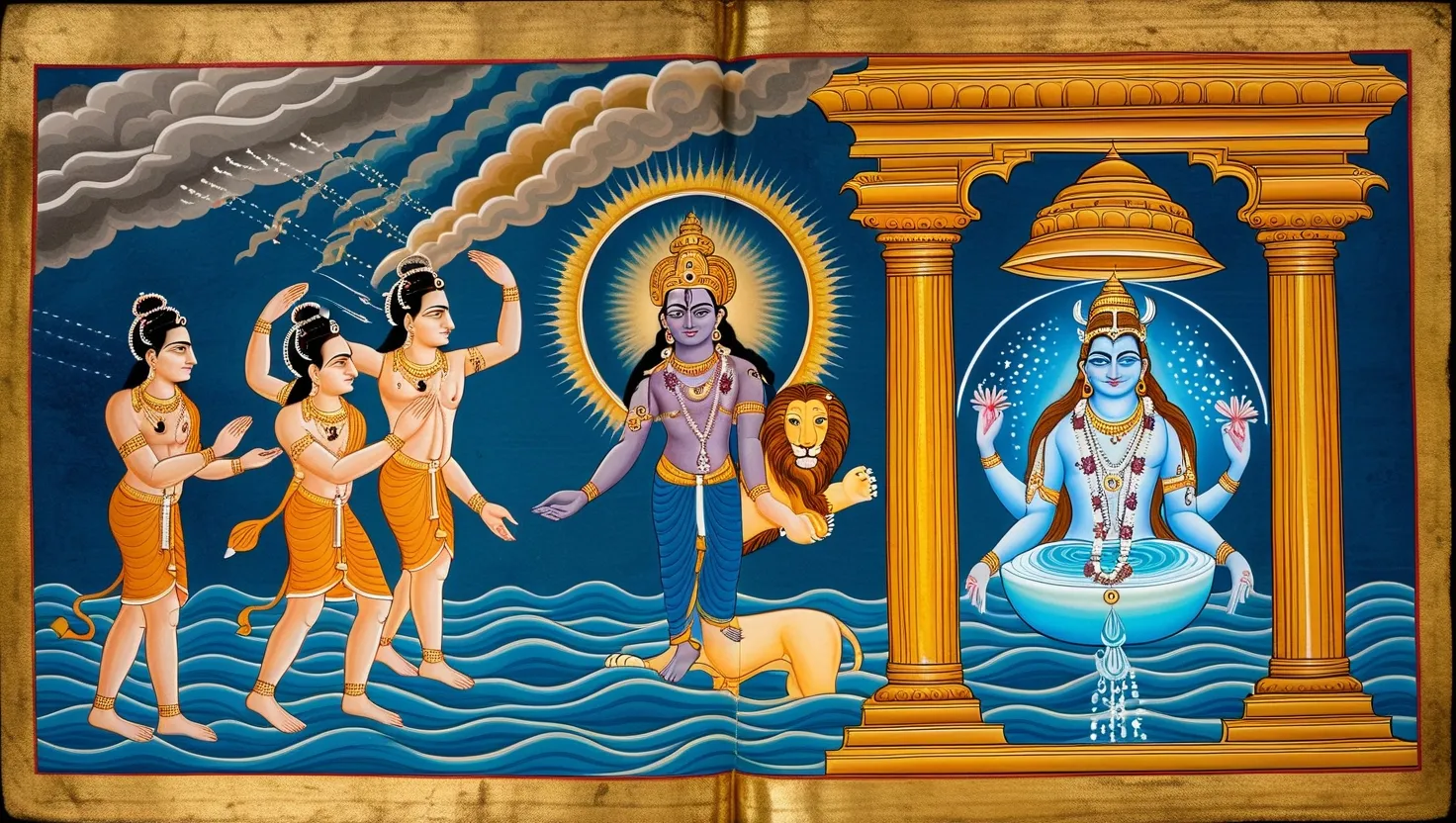
There is a story in the Matsya Purana about a man who found a tiny fish in his cupped hands. The fish asked him not to throw it back into the river, where bigger fish would eat it. The man listened. He carried that fish home, moved it to a bowl, then a pond, then the ocean as it grew enormous. One day, the fish revealed itself as Vishnu and told the man a catastrophic flood was coming. Because the man had shown kindness to something small and helpless, the entire future of humanity was saved.
That is the kind of story the Matsya Purana is built on. Not grand philosophies wrapped in complicated language, but simple, almost childlike tales that carry enormous weight once you sit with them long enough.
Let me walk you through seven lessons from this ancient text that honestly deserve far more attention than they get.
Kindness to the weak is never a waste of time
The man in the story, Manu, did not help the fish because he expected a reward. He helped because the fish was small and afraid. That is the whole point. The Matsya Purana makes it clear very early that compassion directed at the most vulnerable is not sentiment. It is, in some deep cosmic sense, the most practical thing a person can do.
Think about what this means in ordinary life. The colleague nobody takes seriously. The idea that seems too small to matter. The habit you dismiss because it feels minor. What if those are exactly the things worth protecting?
“The strong man is not the one who overcomes others by his strength, but the one who controls himself while in anger.” — Prophet Muhammad
The fish that grew to save the world started in the palm of a man’s hand. Start there.
Old enemies can row the same boat
The churning of the ocean, one of the most dramatic episodes in the Matsya Purana, involves gods and demons working together. They wrapped a cosmic serpent around a mountain and pulled from both ends, churning the ocean to produce treasures neither side could produce alone. They were not friends. They did not trust each other. But they understood that some things are bigger than the fight.
What came out of that ocean? The nectar of immortality. A divine physician. A celestial cow. A goddess. Things that changed everything.
Ask yourself honestly: how many good things in your life have you refused because of who else might benefit from them?
The Purana does not romanticize this alliance. The demons eventually tried to steal the nectar. The gods were not above deception either. But the churning happened, and the world was richer for it.
Form matters, but only when the heart is honest
A surprisingly large section of the Matsya Purana is dedicated to rituals. The exact construction of an altar. The precise sequence of offerings. The correct way to chant. For a modern reader, this can feel tedious. But look closer at what it is actually saying.
The text insists, again and again, that ritual performed without sincerity is hollow. The outer form exists to carry something real. Without the inner intention, you are just building furniture and calling it a temple.
“Prayer is not asking. It is a longing of the soul.” — Mahatma Gandhi
This is not about religion specifically. Any structured practice, whether it is how you start your morning, how you have a difficult conversation, or how you make a decision, works the same way. The form creates the channel. Your intention decides what flows through it.
A leader who stops protecting has already fallen
The Matsya Purana spends considerable time on kings. Not on their glory or their power, but on their obligations. A ruler who neglects the people entrusted to him does not just fail his kingdom. He invites its collapse from the inside.
What makes this interesting is how specific the text gets. It is not enough for a king to avoid being cruel. He must actively look for what is going wrong and fix it before it spreads. Passive goodness is not enough. Protection requires effort, attention, and the willingness to act before things become obvious.
This applies to anyone in a position of responsibility. A parent. A manager. A friend someone has trusted with a secret. The moment you treat your position as a privilege rather than a duty, you have already started losing it.
Some problems need a dramatic solution
The sage Agastya is one of the more unusual figures in this text. When a group of demons hid at the bottom of the ocean and began threatening the gods, nobody could reach them. The ocean was too vast, too deep, too powerful. Agastya walked up to the shore and drank the entire ocean. Just emptied it. The demons had nowhere to hide.
This sounds absurd, and on the surface it is. But the lesson underneath it is not.
“You never change things by fighting the existing reality. To change something, build a new model that makes the existing model obsolete.” — Buckminster Fuller
Some problems cannot be chipped away at gradually. Sometimes the whole system is the problem, and the only real solution is to remove what the problem is hiding inside. The Matsya Purana, to its credit, does not dress this up as anything other than what it is: radical, complete, and effective.
When the age makes righteousness harder, simplify
The Purana describes four Yugas, four great ages of the world, each one worse than the last in terms of how easy it is to live a good life. In the first age, dharma stands on four legs. By the Kali Yuga, the age we are supposedly living in now, it stands on one.
What does the Purana recommend for this age? Not despair. Not elaborate rituals that most people cannot perform anyway. It recommends bhakti, which means devotion, sincere and personal and direct. No complicated intermediary. No expensive ceremony. Just genuine feeling directed toward something greater than yourself.
This is one of the most quietly radical ideas in the text. The very difficulty of the age becomes the argument for a more personal, more direct form of practice. When the road gets harder, you lighten your load. You do not abandon the journey.
To tell the story is to keep it alive
The final sections of the Matsya Purana do something unusual. They talk about the act of reading and reciting the Purana itself. They say that the person who hears these stories, who repeats them, who passes them on, is performing a sacred act.
This is not self-promotion by the text. It is a genuine insight about how knowledge survives.
“The universe is made of stories, not of atoms.” — Muriel Rukeyser
Every generation decides, mostly without realizing it, what gets remembered and what disappears. The stories we tell our children, the histories we bother to keep, the lessons we find worth repeating, these choices shape what the next generation has to work with. The Matsya Purana understood that a moral truth not transmitted is a moral truth lost.
To remember something carefully and pass it on honestly is one of the most undervalued things a person can do. The flood will always come again in some form. The question is whether the boat has already been built because someone, somewhere, thought the story was worth keeping.