Mahabharata's Blindness Paradox: Why Perfect Vision Never Meant True Understanding in India's Greatest Epic
Mahabharata explores true sight vs. moral blindness through Dhritarashtra, Gandhari, and Krishna. Discover what real vision means in this profound epic analysis.
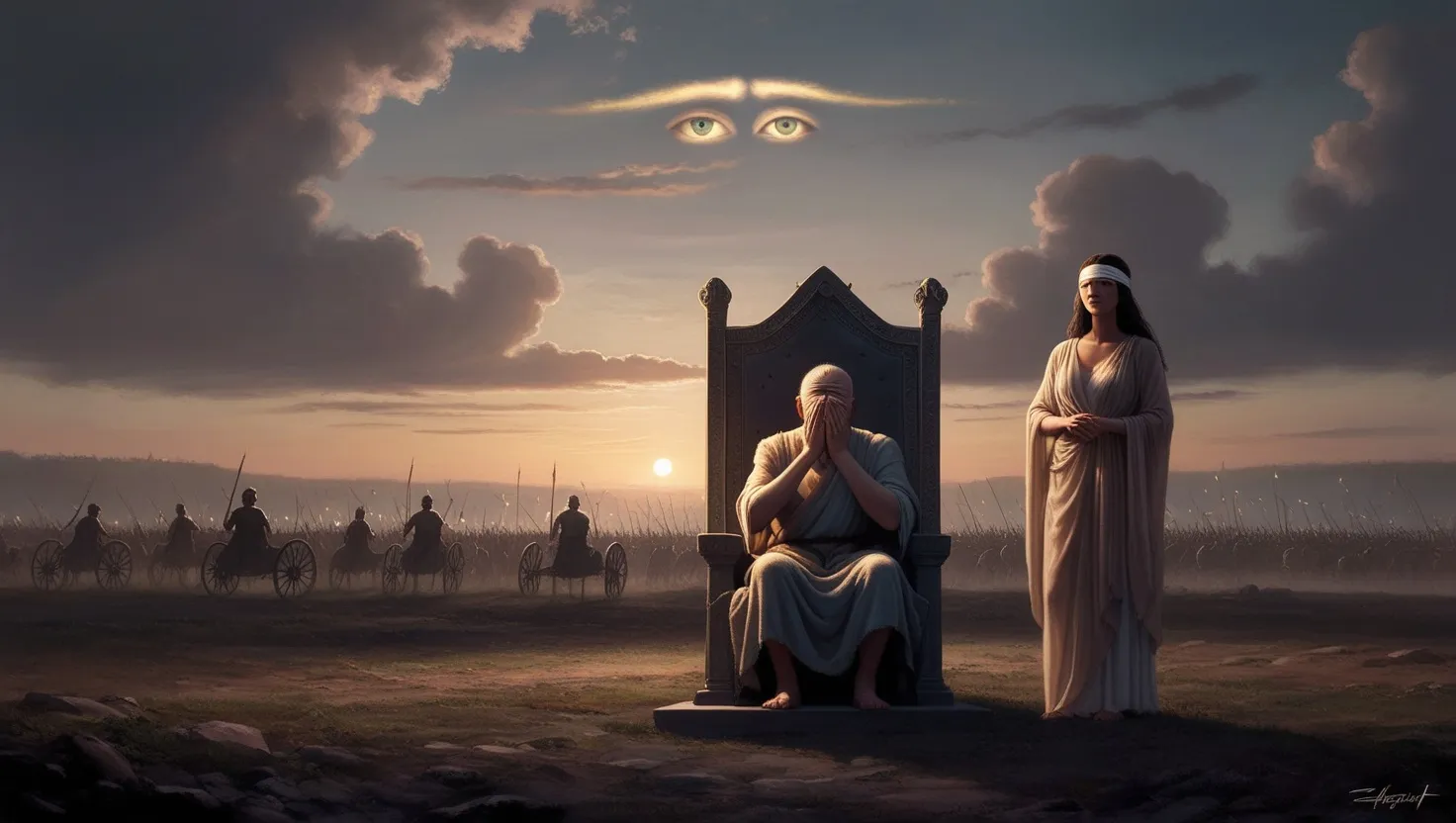
The Mahabharata is a vast examination of what it means to see. It presents a world crowded with characters who possess perfect vision yet remain morally blind, and others whose physical eyes are closed but whose inner sight is terrifyingly clear. The epic never equates eyesight with understanding. Instead, it dismantles the easy assumption that seeing is believing, and it asks a harder question: what does it profit a man to see the whole world if he cannot see himself?
Have you ever noticed how the people who claim to see everything are often the ones who understand nothing about themselves? That is exactly where the epic begins its argument.
Dhritarashtra sits at the center of this inquiry. He is blind from birth, a condition that grants him no special wisdom. His blindness becomes a convenient excuse for a deeper refusal to see. He knows his son Duryodhana is cruel, jealous, and bent on destruction. He hears Vidura’s warnings, Sanjaya’s reports, and Bhishma’s counsel. Yet he chooses not to act. His physical darkness is a mirror for a willful moral darkness. He sees nothing in the outer world, but he also sees nothing in his own heart. The tragedy is not that he cannot see the truth. The tragedy is that he can, and he refuses.
As the poet John Milton once wrote, “The mind is its own place, and in itself can make a heaven of hell, a hell of heaven.” Dhritarashtra proves this line true long before Milton ever wrote it. His mind made a hell of his own kingdom, simply by refusing to look at what stood right in front of him.
Gandhari takes blindness to an extreme. She blindfolds herself for life to share her husband’s fate. This act is often praised as wifely devotion, but the epic quietly undermines that reading. Her self-imposed blindness is a retreat from the world, a refusal to witness the corruption she might have opposed. When her hundred sons are killed, her blindfold becomes a symbol of her complicity. She saw nothing, yet she knew everything. Her curse on Krishna, spoken from the depths of her grief, reveals that her inner vision was never impaired. She saw the truth of the war’s architects with perfect clarity. She simply chose not to look until it was too late.
What good is a blindfold, we might ask, when the heart behind it can still count every wound?
Sanjaya receives the gift of divine sight. Vyasa grants him the ability to see every detail of the Kurukshetra war and narrate it to the blind king. This is not a blessing. It is a sentence. Sanjaya becomes the eyes of a man who will not see. He watches the slaughter of thousands, describes the fall of Bhishma and Drona and Karna, and carries the horror to Dhritarashtra’s ears. His sight is a form of punishment. He is forced to witness what he cannot prevent. The epic suggests that perfect vision without the power to act is its own kind of hell.
Yudhishthira’s blindness is of a subtler kind. He is Dharmaraja, the king of righteousness, and his eyes are fixed on the letter of the law. When Shakuni invites him to the dice game, he accepts because the rules of the Kshatriya code demand that a challenge cannot be refused. He gambles away his kingdom because the code says a king must play. He wagers his brothers and his wife because the same logic extends to every possession. His moral vision is so tightly focused on the rulebook that he cannot see the disaster unfolding before him. He is blind to the difference between dharma and self-destruction. His later refusal to lie, even to save his army, is another form of this blindness. He sees the principle, not the consequence.
The Greek playwright Sophocles once put it plainly: “It is a painful thing to look at your own trouble and know that you yourself and no one else has made it.” Yudhishthira learns this lesson too late, at a dice board he never should have sat down at.
Bhishma is the most tragic of the sighted blind. He knows the Kauravas are wrong. He knows Duryodhana’s cause is unjust. He has spent a lifetime studying dharma and statecraft. Yet his vow of loyalty to the throne blinds him to the higher duty. He fights for the side he knows is corrupt because he cannot see a way to break his word. His blindness is voluntary and complete. He sees the cliff and drives the chariot over it anyway, because the rules of his own making will not allow him to turn the reins.
Isn’t it strange how a vow made in youth can blind a man in old age, long after the reasons for it have crumbled to dust?
Duryodhana’s blindness is born of envy. He sees every slight, every imagined conspiracy, every sign that the Pandavas are favored. He does not see his own part in the hatred. He does not see that his refusal to share a needle-tip of land is the cause of his ruin. His vision is turned completely inward and completely wrong at once. He sees his enemies with crystal clarity and himself not at all. The epic offers no cure for this kind of blindness. It simply shows where it leads.
Karna’s blindness is about identity itself. He cannot see his own origin. He builds a life on the belief that he is the son of a charioteer. When Krishna reveals the truth on the eve of battle, offering him the kingdom and his mother’s love, Karna refuses to see. He chooses the loyalty he knows over the family he never had. His blindness is not a lack of information. It is a refusal to rewrite the story of his own life. He would rather die as the man he became than live as the man he was born to be.
Would you trade the truth of your birth for the loyalty you built with your own hands? Karna answers that question with his life.
Krishna alone possesses unclouded sight. He sees the past, the present, and the future. He sees the war as a necessary cleansing, a hard correction for a diseased world. He sees Arjuna’s paralysis as a temporary blindness that must be cured. He sees the deaths of Bhishma, Drona, Karna, and Duryodhana as unavoidable. His vision is vast, and it is lonely. He cannot make others see what he sees. He can only guide, nudge, and sometimes deceive. His divine sight is not a gift to be shared. It is a weight he carries alone.
Arjuna’s brief blindness on the battlefield is the epic’s most famous case. He sees his teachers, his grandfather, his cousins, and his friends arrayed against him. He sees the sin of killing kin. He is blinded by grief and moral horror. Then Krishna speaks the Bhagavad Gita, and a new kind of sight is offered. Arjuna learns to see the eternal self beyond the body, the duty beyond the emotion. He raises his bow not because he has stopped seeing the tragedy, but because he has learned to see it differently. His blindness becomes the doorway to insight.
As the philosopher Henri Bergson once said, “The eye sees only what the mind is prepared to comprehend.” Arjuna’s eyes did not change on that battlefield. His mind did.
The final journey to the Himalayas offers a last lesson in sight. Yudhishthira walks with his brothers and Draupadi. One by one they fall. He does not look back. He does not mourn. He simply continues. When a stray dog follows him to the gates of heaven, Indra tells him to leave the creature behind. Yudhishthira refuses. He will not enter paradise without the dog. This is his final test, and he passes because he sees what others do not. The dog is Dharma, his father, in disguise. The man who was blind to the consequences of the dice game has learned to see the divine in the lowliest form.
What would you have done at those gates? Walked in, or turned back for the dog?
The Mahabharata does not offer a simple moral. It does not say that the blind are wise or that the sighted are foolish. It says that seeing is not enough. The eyes can be open and the heart closed. The eyes can be closed and the heart wide awake. The epic is a mirror held up to its characters, and to us. It asks what we are blind to, and what it would take to see. The answer is never easy. The answer is often a curse or a war or a long walk into the mountains. But the question remains, and that is the point.