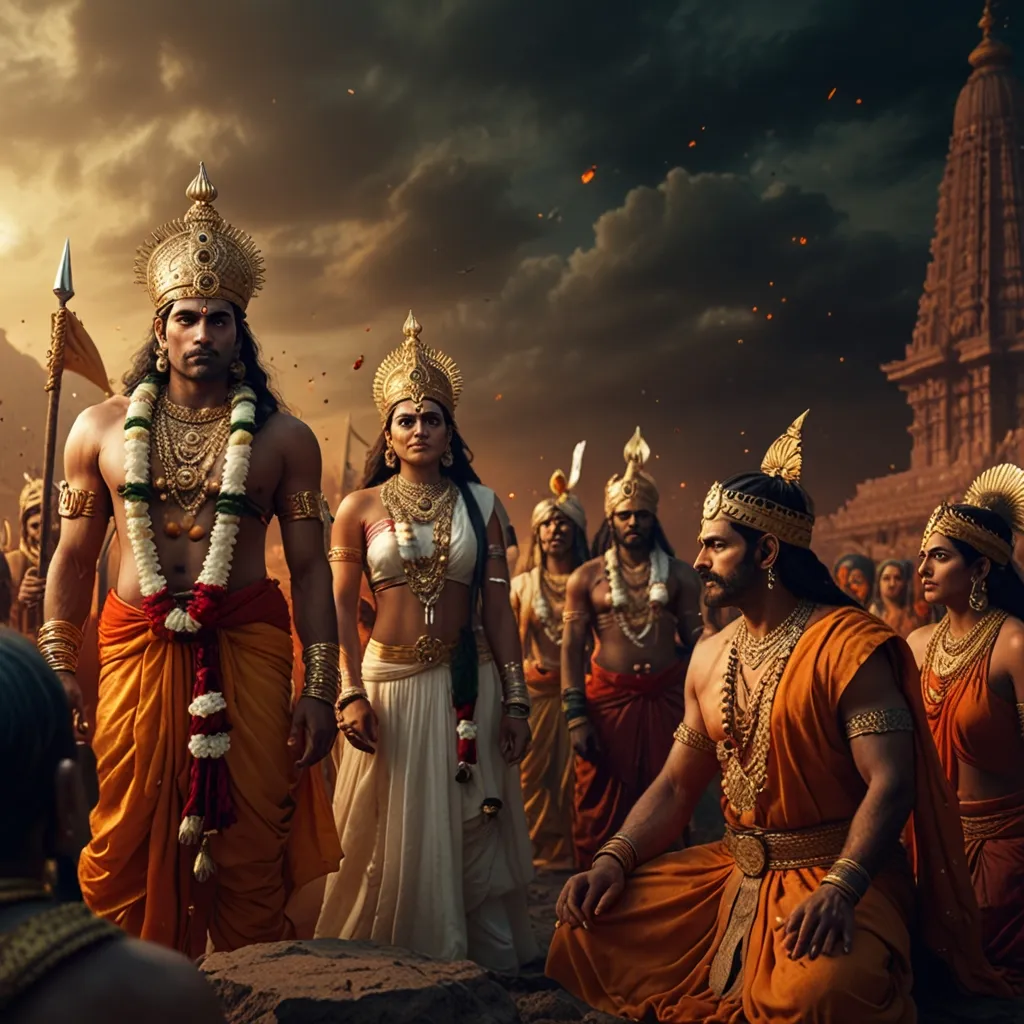
A name in the Mahabharata is never just a label. It is like a story squeezed into one word, a story that everyone around the person keeps repeating until even the person begins to believe it. I want you to read this not as a scholar, but almost like a child hearing a story for the first time. So I will keep it very simple, and I will ask you often: what would you do if you carried such a name on your shoulders?
There is a famous line often quoted when we speak of names and identity:
“That which we call a rose
By any other name would smell as sweet.”
— William Shakespeare
On the surface, this sounds nice: change the name, the thing stays the same. But the Mahabharata quietly argues with this idea. In that world, a name can change how people treat you, how you treat yourself, and even how you meet your end.
Take Yudhishthira. Everyone calls him Dharmaraja – the king of righteousness. Sounds noble, right? But imagine this: every time you are about to make a choice, a voice in your ear whispers, “Remember, you are the perfect one.” Could you ever be relaxed? Could you ever admit you are confused?
For Yudhishthira, the title is like a crown welded to his head. It guides him, but it also traps him. He cannot just be a tired man who makes a mistake. He has to be the living standard of dharma. When he gambles away his kingdom, his brothers, and Draupadi, we often ask, “How could Dharmaraja do this?” But maybe that is the wrong question. Maybe we should ask: did he gamble partly because he believed that whatever he did must somehow be right, simply because he was Dharmaraja?
Later, when he is forced to utter a half-truth about Ashwatthama’s death, the weight of that name finally cracks. The king of righteousness must lie to protect a larger order. Do you see the trap? The name demands perfect truth, but the world demands messy choices. His identity becomes a tiring show he has to keep performing. Have you ever felt forced to “play your role” even when it hurts you?
Then there is Karna. For most people in the epic, he is Sutaputra – the charioteer’s son. One cold word erases his skill, his courage, even his secret royal birth. It does not matter how well he shoots an arrow; for many, he is still just the boy from the wrong family.
Here is a line that could easily belong to Karna’s life:
“It is not my nature that brands me, but the name others shout when they wish to put me in my place.”
— Anonymous
The brutal thing about Karna’s name is that it sits at the edge of truth and insult. Yes, he was raised by a charioteer. That part is true. But people use this truth like a weapon. Every time he reaches up, the word “Sutaputra” yanks him down. Over time, he uses that same word as fuel. He gives away everything in charity. He fights like a man who has to prove, again and again, that he deserves to stand where he stands.
Ask yourself: if you are told from childhood that you are “less than,” would you quietly accept it, or would you cling to the first person who treats you as “enough”? Karna chooses Duryodhana not simply because of power or friendship, but because Duryodhana gives him a new name: king, friend, equal. That one act binds Karna more tightly than any rope.
Yet there is a sad twist. Even Karna’s greatness is still framed by the old insult. People do not say, “Karna the warrior.” They say, “Karna, though a Sutaputra, is so great.” His praise always carries a shadow. His whole life becomes a long answer to an unkind name.
Now think about Draupadi. She has many names: Panchali (from Panchala), Krishnaa (dark-skinned or linked to Krishna), Yajnaseni (born of sacrifice). Each name pulls her toward a different origin. One points to her land, one to her appearance and divine link, one to the fire from which she emerged.
These names together paint a rich image: a woman of fire, politics, and deep presence. But watch what happens in the dice hall. The respectful titles slowly slip away. She becomes “wife,” then “stake,” then, in the eyes of some men, just “property.”
Can you feel the horror of that shift? No one had to raise a sword yet. The first attack was on her name. Once you stop calling someone by their human titles, it becomes easier to do inhuman things to them. Calling her “property” paves the way for the attempt to strip her.
Here a different famous quote fits:
“The limits of my language mean the limits of my world.”
— Ludwig Wittgenstein
When the language used for Draupadi shrinks, her world is supposed to shrink too. But she does something powerful: she fights not only for her body but for her name. She asks questions in that hall. She demands to know if she, as a wife, could even be gambled away. Her sharp questions pull her name back from “thing” toward “person.” Notice how unusual this is: in a crowded royal court, the one treated as an object refuses to answer to that role.
Have you ever been called something that made you feel smaller – maybe “lazy,” “difficult,” or “stupid” – and then felt the urge to shout, “That’s not who I am”? That small shout is what Draupadi does on a massive scale.
Bhima shows us another side of how a name can be both gift and cage. He is called Vrikodara, “wolf-bellied.” It paints him as huge, hungry, full of raw power. This name tells everyone what to expect: Bhima is the strong one, the one you send to break bones, to keep oaths of revenge, to perform the loud, rough tasks.
But the same name can blind others to his softer parts. People forget that he is also the one who feeds the family in the forest, who cares deeply for his mother, who shares a simple, honest bond with Draupadi. When your main label is about strength and appetite, who bothers asking how you feel?
Think about real life. The “smart one” in the family is not allowed to be confused. The “strong one” is not allowed to cry. The “funny one” is not taken seriously when they speak in pain. Do you recognize this pattern?
“We know what we are, but know not what we may be.”
— William Shakespeare
Bhima’s name tells everyone what he is: powerful, fierce. But it quietly tells them what he is not allowed to be: delicate, doubtful, vulnerable. The name simplifies him so that others can feel safe; they know exactly which button he is meant to press in the family machine.
Now look at Duryodhana. In many retellings we see mostly the name “Duryodhana,” often taken to mean “hard to conquer in battle” but also colored by moral judgment. Yet another name for him is Suyodhana, “good warrior” or “noble fighter.” The choice of name becomes almost a moral vote.
If you like him, or if you are trying to argue his side, you may call him Suyodhana. If you see him as villain, you stick to Duryodhana. So even his identity is split. Two names tug him in two directions. One underlines his skill and courage; the other colors him with darkness and rejection.
This is where the Mahabharata does something quite subtle. It lets different voices choose different names. There is no single, fixed label from above. The text almost asks us: who gets to decide a person’s main name – their enemy, their friend, or their own heart?
Have you noticed how in your own mind you may rename people based on how you feel about them? “That teacher” becomes “that tyrant,” or “that strict teacher who saved my career.” The outer person is the same, but your private name for them changes their story in your head.
Krishna sits in a different category. He has so many names that they almost refuse to fit into one human idea: Govinda, Madhusudana, Vasudeva, Janardana, and many more. One name ties him to cows and pastures. Another says he kills demons. Another says he is Vasudeva’s son. Another marks him as wise, another as cosmic.
Where Yudhishthira is held tightly by one heavy title, Krishna moves through many with ease. He can be a charioteer for Arjuna, a messenger for peace, a playful cowherd in songs, and the voice of a universal form in the Bhagavad Gita. No single word can hold him.
Here is a line that captures this:
“I am large, I contain multitudes.”
— Walt Whitman
Krishna’s many names teach us something important: sometimes the only honest way to speak about a person is to accept that one label will never be enough. Instead of cutting him down to “just a god” or “just a clever politician,” the tradition lets all the names float around him, like mirrors showing different faces.
Now let us pause and ask: what does all this say about us, not just about epic heroes?
In the Mahabharata, names act like scripts. Yudhishthira tries to live the script of Dharmaraja. Karna tries to tear up the script of Sutaputra and write a better one. Draupadi fights when someone tries to rewrite her script from queen to object. Bhima acts out the script of the tough protector while secretly holding much more. Duryodhana’s script depends on who is writing: friend or foe. Krishna seems to move between scripts so quickly that the scripts themselves start to look thin.
In our own lives, we carry smaller but similar scripts. Maybe you were told, “You are the troublemaker,” and then you kept getting cast in that role at school. Or you were the “good child” who never protested, even when something felt wrong, because your family was proud of that name and you did not want to disappoint them.
Here is another quote to sit with:
“Names are the way we fix the world in our minds. But the world refuses to stay fixed.”
— Unknown
The epic shows again and again that people are bigger than the names given to them, yet those names still shape how events unfold. Yudhishthira’s title pushes him into paralysis. Karna’s label feeds his loyalty and his tragedy. Draupadi’s many names give her strength, but the temporary loss of them puts her in mortal danger. Bhima’s name keeps him from being fully seen. Duryodhana’s two names cause constant argument, even among readers today. Krishna’s many names remind us that some identities are too wide for one line of text.
Let me ask you some direct questions now, and I want you to answer them honestly to yourself.
What is the main name you carry in your family or friend circle? Is it “smart,” “lazy,” “quiet,” “dramatic,” “reliable,” “selfish,” “strong,” “sensitive”? Who gave you that name? Did you agree to it, or was it placed on you?
When you make a choice, do you first ask, “What would someone like me do?” If yes, then you are already living with a script, just like the characters in the Mahabharata. Sometimes that script protects you. Sometimes it suffocates you.
One of the quiet lessons of the epic is this: a name is a story, not a fact. But stories are powerful. They can heal or hurt, guide or mislead.
If you take anything from this, take this simple thought: you are allowed to question the names that limit you. You are allowed to say, as Draupadi did in that court, “Who decided this about me?” You are allowed to be, like Krishna, “many things” instead of only one tidy word.
And when you speak about others, remember what happened when Draupadi was called “property” or when Karna was reduced to “Sutaputra.” Before you use a label, ask: will this word make it easier to respect this person, or easier to dismiss them?
“Be careful how you name people in your mind. One day you may treat them exactly as that name deserves.”
— Adapted from an old saying
The Mahabharata might be an ancient story, but its lesson about names is painfully modern. We still crush people under wrong labels. We still expect perfection from those we call “good” and condemn forever those we call “bad.” We still forget that behind every tag there is a full, changing, complicated human being.
In the end, the epic seems to whisper a soft warning: do not let a single word become your whole world. Wear your names lightly. Use them when they help you act with more courage, more clarity, more kindness. Drop them when they turn into cages.
And the next time you hear someone introduce a character from the Mahabharata with an epithet – Dharmaraja, Sutaputra, Panchali, Vrikodara, Suyodhana, Govinda – pause for a moment and ask: what weight does that one word carry, and who is strong enough to carry it?