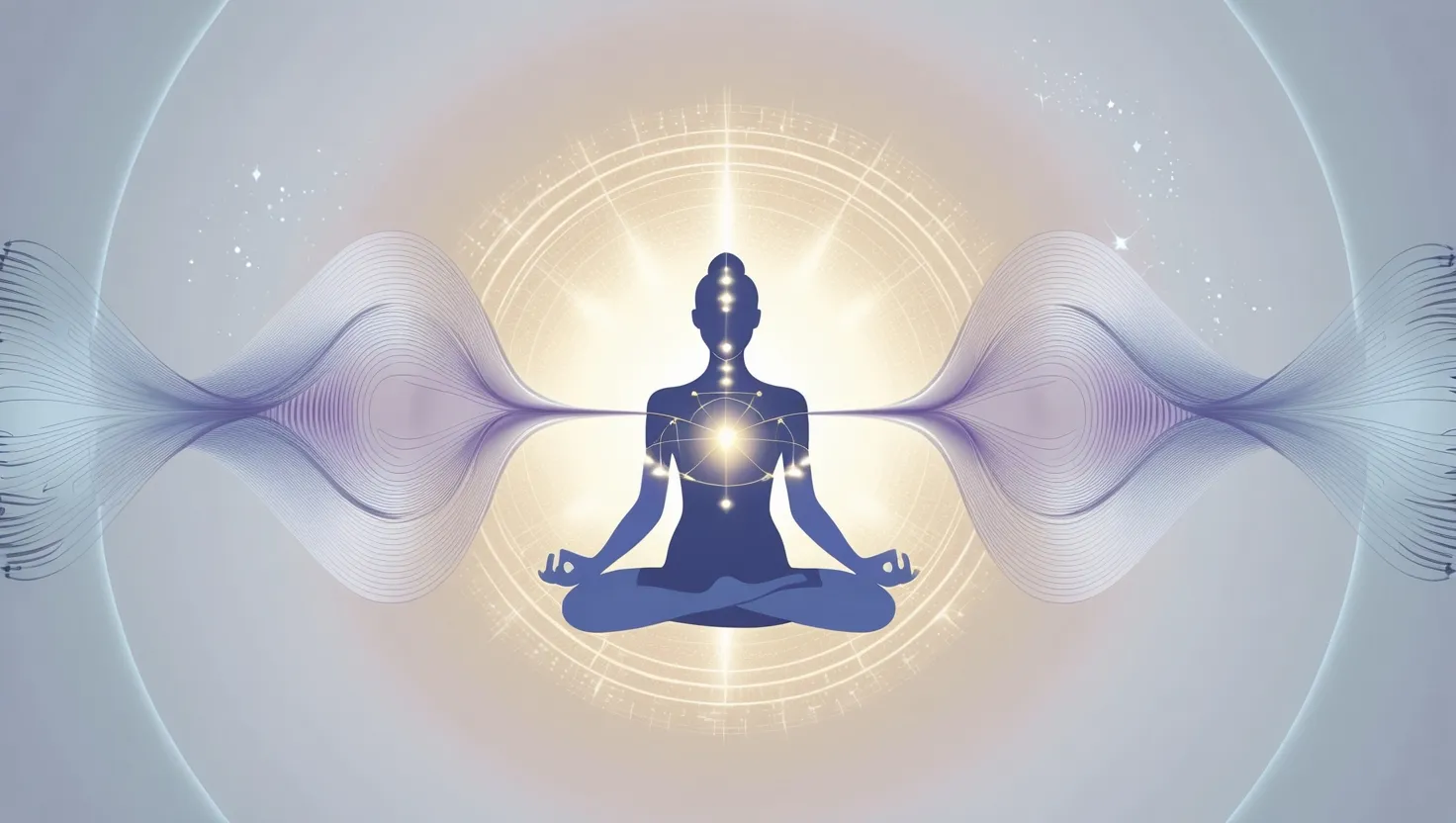
The Resonance of Creation: How Sacred Sound Built Everything
Reality vibrates. That’s not poetry or metaphor—it’s the foundation of one of humanity’s oldest and most sophisticated philosophies. In Hindu thought, everything you see, hear, and experience originates from one fundamental truth: sound. Not the sound you hear with your ears, but a primordial vibration that precedes all existence. The Sanskrit term for this is Śabda Brahman, which translates simply as “sacred sound” or “the absolute expressed as vibration.” Think of it like this—if God or the ultimate reality had to choose a medium to create the universe, ancient Hindu philosophers said it would choose vibration.
The Vedas, the oldest Hindu scriptures written over three thousand years ago, describe the cosmos not as created all at once like flipping a switch, but as constantly emerging from sound. These sacred texts aren’t considered human inventions. They’re called Śruti, meaning “that which is heard.” The difference is crucial. A written book can be lost or forgotten, but something that is “heard” exists on a different level entirely. Ancient seers, called Ṛṣis, were believed to have directly perceived these eternal vibrations, these cosmic hums that existed before language, before humans, before everything material.
“In the beginning was the Word, and the Word was with God, and the Word was God.” — While this comes from a different tradition, it echoes a similar insight about vibration as foundational reality.
Let me make this concrete. Imagine sound as the alphabet of reality. Every physical thing you can touch, see, or measure is a combination of these sonic letters arranged in specific patterns. Your body is a particular arrangement. The chair you’re sitting on is another arrangement. The planet Earth is yet another arrangement. All of them—fundamentally—are organized vibrations. This isn’t abstract philosophy confined to ancient texts. Modern physics keeps discovering this same basic principle through completely different methods.
The Sanskrit language itself embodies this cosmology in a unique way. Each of the fifty letters of the Sanskrit alphabet corresponds to specific cosmic energies and principles. When you speak Sanskrit, you’re not simply making sounds to communicate thoughts. You’re aligning your individual vibration with the cosmic vibration. It’s the difference between reading a recipe and actually cooking the meal. The recipe is just information, but cooking creates something real and tangible. Speaking Sanskrit, in this view, is like cooking with the fundamental ingredients of reality.
This leads to a practice called Nāda Yoga, which translates as the “yoga of sound.” Unlike physical yoga that stretches muscles, Nāda Yoga is an internal practice. Practitioners sit quietly and learn to perceive the subtle vibrations within their own bodies. They listen inward, finding what’s called Anāhata Nāda—literally, the “unstruck sound.” This is sound without a source, vibration that resonates without anything striking anything else. It’s the background frequency of your own being. As you practice, you begin to recognize that this unstruck sound inside you is the same as the cosmic vibration outside you. The boundary between inner and outer dissolves.
Here’s where it gets interesting. In classical Indian music, these principles aren’t theoretical abstractions. A musician trained in the raga system is doing something far more complex than playing notes in a sequence. Each raga—a melodic framework used in Indian classical music—is designed to manifest at specific times of day or during particular seasons. The raga for early morning sounds and feels completely different from the raga for evening. A musician playing a raga at the “wrong” time feels like wearing winter clothes in summer. It’s technically possible but fundamentally misaligned.
What’s the musician actually doing? They’re calibrating their own vibration to match the vibration of the cosmos at that particular moment. It’s like tuning a radio to the right frequency. When properly tuned, something magical happens. Energy flows. Information moves. The boundary between performer and listener dissolves. Everyone in the room resonates together at the same frequency.
Have you ever felt this? When great music moves you, when everyone in a concert venue suddenly feels unified, when a speaker’s words genuinely change how you see things—that’s resonance. Multiple vibrations synchronizing into a coherent whole.
Now here’s where ancient philosophy and modern science stop being separate conversations. String theory, one of the most advanced frameworks in theoretical physics, proposes that the fundamental particles making up reality aren’t actually solid things at all. They’re vibrations. Imagine the universe as an infinite ocean with countless strings vibrating in multidimensional space. Different vibration patterns create different particles, which combine into atoms, which combine into molecules, which combine into everything you can see. Quantum field theory pushes this further, describing a universe composed entirely of interacting vibrational fields. What we call “matter” is just concentrated energy in particular patterns of vibration.
The cosmic microwave background radiation, detected by scientists throughout the universe, is literally the echo of the Big Bang—the universe’s original vibration still resonating billions of years later. When physicists study this radiation, they’re studying the fingerprint of creation itself, and it’s expressed as waves and frequencies and vibrations. Science is describing, through mathematics and measurement, the exact same phenomenon that ancient Hindu philosophers described through meditation and reflection.
“The universe is not made of atoms. It’s made of stories.” — Muriel Rukeyser’s observation captures something true about vibration—that reality is fundamentally communicative, relational, and meaningful.
There’s a fascinating implication here that most people miss. If reality is fundamentally vibrational, then consciousness and sound are not separate things. They’re expressions of the same underlying principle. This would explain something that neuroscience finds genuinely puzzling: why words and sounds have such powerful effects on our consciousness. A particular song can shift your mood entirely. A meaningful conversation can change how you see yourself. Harsh words can hurt as much as physical blows. This isn’t magical thinking. If consciousness and vibration are two sides of the same coin, then sound literally works with the substance that consciousness is made of.
This ancient philosophy invites you to consider your sonic environment as a form of medicine or poison. What frequencies are you immersed in daily? Music, podcasts, conversations, background noise—all of these are literally shaping your consciousness. The noise in modern cities isn’t neutral. Constant harsh sounds create constant low-level discord in your nervous system. Silence becomes precious because it’s the field from which all coherent sound emerges. Without silence, vibration becomes merely noise.
Consider how language itself works under this framework. Words aren’t neutral labels you attach to things. The word you use to describe something actually shapes how you experience it. In Sanskrit, this principle is explicit. A mantra isn’t a wish or a request. It’s a precise vibration designed to produce specific effects on consciousness. When you repeat “Om”—the primordial sound representing the entire universe—you’re not asking the universe for anything. You’re synchronizing your vibration with the fundamental frequency of reality itself.
The practice of conscious listening becomes something profound under this philosophy. Most people listen casually, extracting only the information they want while filtering out the rest. But what if listening consciously—really paying attention to the qualities of sound, the spaces between sounds, the resonance that sound creates in your body—is a spiritual practice? The Śabda Brahman philosophy suggests it is. When you listen to another person deeply, you’re not just receiving information. You’re synchronizing your vibration with theirs. Connection becomes possible at a fundamental level.
What does all this mean for you practically? It suggests that every word you speak carries weight. Every sound you create or consume shapes the vibrational field you inhabit. The music you listen to isn’t just entertainment—it’s literally reorganizing the patterns of your consciousness. The quality of your listening literally affects the quality of your connection with others.
In a world increasingly fragmented by competing frequencies, competing messages, and constant noise, this ancient framework offers something vital. It reminds us that we’re not separate observers of reality. We’re participants in a cosmic vibration. Every word, every sound, every moment of listening or speaking is an act of creation. We’re constantly tuning ourselves and our world to particular frequencies. The question becomes: what frequency do you want to resonate at?
The philosophy of Śabda Brahman doesn’t ask you to accept anything on faith. It invites you to listen—to yourself, to others, to the subtle vibrations underneath all apparent stillness. When you do, you might discover what ancient seers knew: reality hums with meaning, and you are part of that song.