Hindu philosophy does something very unusual with teaching: it does not always try to make things clear. It often makes things confusing on purpose. Those strange, contradictory lines are not mistakes; they are tools. They are meant to push the mind so hard that it finally drops some of its old habits and sees in a new way. If you have ever felt both attracted and annoyed by a paradox like “It moves, it moves not,” you have already tasted this method.
Let me start simple. Most of us like clean answers. We want yes or no, true or false, this or that. Hindu philosophy keeps saying, “Both,” and then adds, “and neither.” At first, this feels like someone is playing word games. But ask yourself: does real life always fit simple either/or boxes? Are you only a body, or only a mind? Only a good person, or only a bad person? The moment you try to answer honestly, you can feel the categories breaking down. That breaking is exactly what the tradition is aiming at.
There is a reason the Upanishads sound so strange. When they say things like “It is far, it is near,” they are not trying to describe an object you can measure with a ruler. They are talking about a reality that is not sitting in a particular place in space, yet is not absent anywhere either. The mind immediately protests: “That makes no sense.” This protest is important. It shows that the old mental map no longer works here. Instead of giving you a new, neat map, the text forces you to sit in that “this makes no sense” feeling. From there, a different kind of seeing slowly grows.
“Out beyond ideas of wrongdoing and rightdoing there is a field. I’ll meet you there.”
This famous line from a Sufi poet captures the same spirit: some truths are not inside the usual boxes of right/wrong or this/that. Hindu seers learned that if they spoke too clearly, people would simply add one more concept to their collection and move on. So they used paradox to jam the gears. Do you notice how your mind wants to “fix” a paradox into a neat formula? That itch to fix is what the paradox keeps refusing to satisfy.
Adi Shankara turns this into an art. In his commentaries, especially on texts like the Brahmasutra, he lines up different viewpoints with great care, gives each one its best possible argument, and then tears it apart. If he just wanted to win a debate, he could stop once his side looks stronger. Instead, he keeps going until every fixed position looks shaky, including the ones you liked a moment ago. Why would a teacher do that? Because the deeper truth he points to is not just another “position.” When the mind finally sees that every fixed view has limits, it becomes humble and quiet enough for a more direct seeing to happen.
Have you ever argued with someone and suddenly realized that even your own argument feels thin? That hollow feeling—where words keep coming but no longer feel solid—is close to what Shankara aims at in his students. It is not to make them blank or helpless. It is to clean out the stubbornness that clings to concepts. After that cleaning, the simple statement “You are That” does not land as a slogan; it lands like a shock. The ground you thought you stood on is gone, and yet nothing actually disappeared.
“Confusion is the first step toward clarity.”
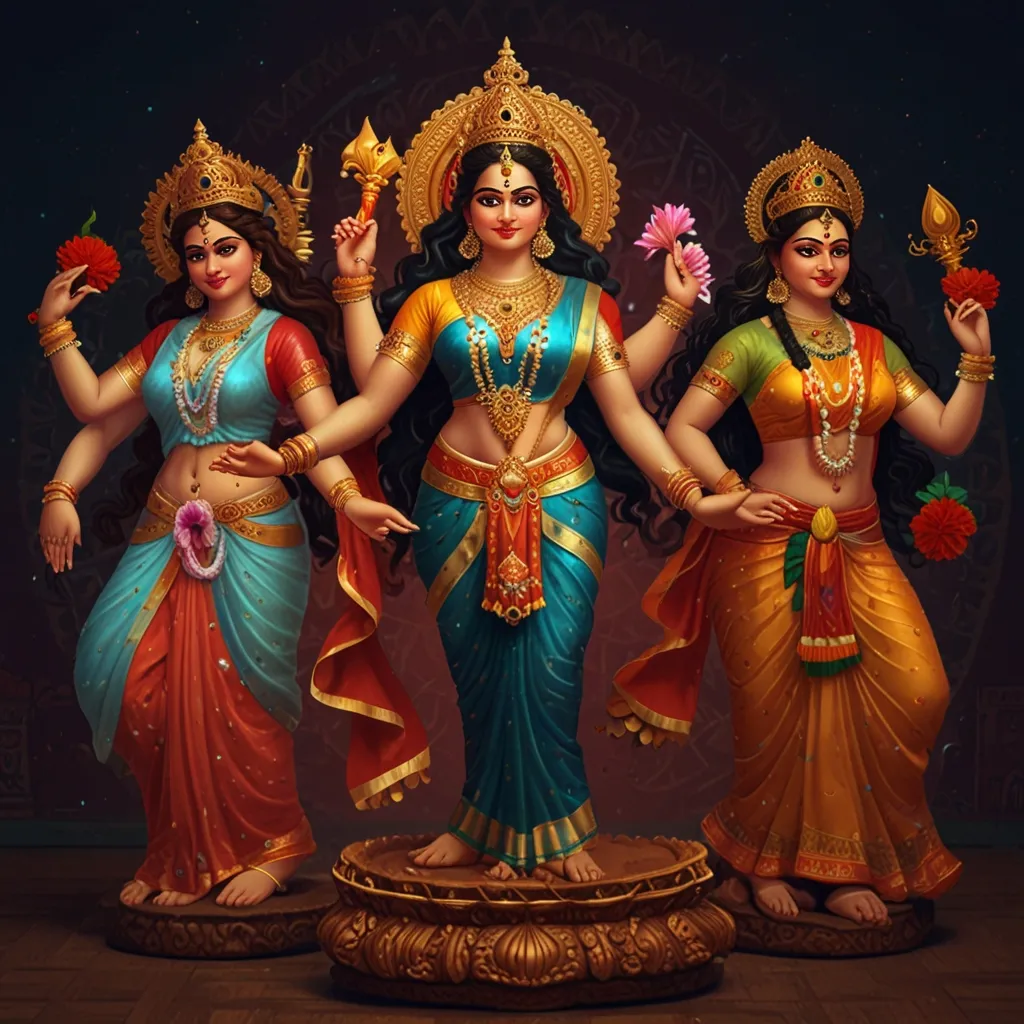
Many spiritual stories in Hindu tradition use the same trick but in colorful ways. Gods behave in ways that break neat categories. Shiva is a perfect example: he lives like a homeless ascetic but is also a loving husband and father; he destroys worlds yet is called the great benefactor. How do you fit that into a simple moral lesson? Vishnu is both the quiet, resting cosmic presence and the active preserver who takes birth again and again. Kali is terrifying, covered in skulls, yet also seen as the tender mother. Are these just wild imaginations, or are they training your mind to hold opposites at once?
Think about how we usually respond to such figures. We want to label: “good god, bad god, peaceful god, angry god.” The stories refuse to stay inside these boxes. If you stay with them long enough, you start to feel a new ability: you can sense that reality can be both gentle and fierce, both chaos and order, without being broken into two separate things. This is an emotional training in paradox. It stretches the heart, not just the intellect.
The Upanishads constantly push this further. They say the Self is “smaller than the smallest and larger than the largest,” present in the tiniest atom and also beyond the widest sky. Try to picture that. Quickly, you find that images fail. This is the point. The text walks you right up to the edge of what the imagination can handle and then quietly stands aside. Do you notice what happens right at that edge? For a brief moment, thought stops. There is a pause. That pause is the real classroom.
“Do not seek to follow in the footsteps of the wise. Seek what they sought.”
Now, let’s connect this ancient method to how the mind works. Modern psychology shows that often, before a creative “aha!” moment, people feel stuck and frustrated. They wrestle with conflicting clues that do not fit any known pattern. At some point, the old pattern simply collapses, and a new one appears suddenly. Hindu philosophers did not have brain scans, but they understood this inner rhythm very well. So they designed teachings that deliberately create that stuck, “this doesn’t compute” feeling. The paradox is like a mental puzzle that cannot be solved by old habits.
Think of a line such as “Act without acting.” At a surface level, it sounds empty. But if you sit with it, questions arise: Can I move without the usual inner pushing and pulling? Is there a way to let actions happen through me rather than from a tight “me”? The paradox does not give you a manual. It gives you a direction to look. If you stay honest and keep watching your own behavior, you may suddenly see a moment when action happens with no inner strain, like breathing. Then the line “Act without acting” stops being nonsense and becomes a description of something you have tasted.
Here is a simple exercise you can try. Sit quietly and say to yourself, “I am everything, and I am nothing.” At first, it may sound silly. One part of you may say, “Of course I am not everything.” Another may say, “I am not nothing either.” Let both protests speak. Feel the tug-of-war. Keep repeating the phrase, not as a slogan, but as a genuine question: “In what sense could both be true?” Slowly, you may notice that your usual “I” (this body, this story, this history) feels too small to be everything, and too specific to be nothing. A subtle shift can happen where “I” starts to feel more like a space in which experiences appear rather than just one object inside that space. This shift is tiny but powerful.
“Who am I?” is perhaps the most famous paradoxical question in this tradition. On the surface, it sounds straightforward. But when you actually try to answer deeply, every answer—“I am the body,” “I am my thoughts,” “I am my feelings”—can be questioned. You see that you can notice the body, thoughts, and feelings. If you can notice them, they are objects. Then who is the noticer? The question eats all your old answers. Finally, it starts to eat itself, and there is just a quiet, alert presence. Teaching, in this mode, is not about giving you the right answer. It is about giving you a question that removes every wrong answer, including the idea that you are just a questioner.
Have you noticed that in normal schooling, contradiction is treated as a problem to be removed? Here, contradiction is treated as a medicine. The trick is dosage. Too little paradox, and you stay stuck in old habits. Too much, and you may feel lost or even disturbed. That is why traditional teachers often gave paradoxes step by step, watching the student’s mind. They did not throw the most extreme statements at everyone on day one. They stretched the mind the way a physiotherapist stretches a stiff muscle: enough to go beyond comfort, not so much that it tears.
This approach has a lot to offer modern education. We live in a world full of hard tensions: freedom versus security, individual rights versus common good, economic growth versus environmental health. Very often, public debate turns these into simple fights: pick a side and attack the opposite. But many of these issues cannot be solved with either/or thinking. They require holding two truths at once and looking for creative ways they can coexist. Hindu philosophy’s comfort with paradox is not only a spiritual asset; it is a training for this kind of both/and thinking.
“Intelligence is the ability to hold two opposed ideas in mind at the same time and still retain the ability to function.”
Imagine a classroom where, instead of rushing to the “correct” view, students were invited to list the strongest reasons for each opposing view, and then sit with the discomfort of seeing value in both. Over time, this builds intellectual humility: the sense that one’s own perspective is partial, not absolute. It also trains patience with ambiguity—an essential skill when facing complex global problems. Rather than teaching only facts, such a method shapes how students relate to uncertainty itself.
For personal growth, paradox can be a gentle mirror. Take the line “You are already free, and yet you must strive.” On one side, it says your deepest nature is untouched and complete. On the other, it clearly says work is required. If you lean only on “already free,” you may become lazy. If you lean only on “must strive,” you may become tense and harsh on yourself. Holding both together helps you act with effort but less inner pressure. Have you ever tried doing your best while also accepting that your deeper worth does not depend on the result? That is this paradox in daily life.
When contemporary teachers in these traditions speak with students, they often use small paradoxes in conversation. If a student says, “I feel far from the goal,” the teacher might respond, “The one who feels far is itself the goal.” The sentence sounds like a trick at first. If the student just repeats it like a slogan, nothing changes. But if the student looks honestly: “Who is this ‘I’ that feels far? What is it made of?” the line becomes a doorway. The teacher is not asking the student to blindly accept a new belief; the teacher is shifting the student’s attention.
“Zen is not some kind of excitement, but concentration on our usual everyday routine.”
What is striking is how ordinary life becomes the training ground. You do not need to sit in a cave to use paradox. Next time you are angry at someone, try this: notice how your mind wants to make them completely wrong and you completely right. Then quietly ask, “In what way am I right, and in what way might they also be right?” You are not letting them off the hook; you are stretching your own categories. Or when you are full of self-doubt, ask, “In what way am I small, and in what way am I not limited to this small story at all?” These tiny paradoxical questions slowly weaken rigid patterns.
The most radical idea behind all this is simple to say and hard to live: ultimate reality, in this view, is not a thing inside our usual pairs of opposites. It is not one pole of a pair (like “only stillness” against “movement”) but the basis in which both show up. So if a teaching stays completely inside language that picks sides, it will never point beyond. Paradox is the way language hints at what is beyond language. It is like a sign that points at itself and says, “Do not stop here.”
So when Hindu philosophy sounds contradictory, it is not being careless. It is using contradiction as a ladder. You climb the ladder of ideas and then notice that the view from the top is not the ladder at all. The mind has to get skillfully confused before it can loosen its grip on its own limits. Paradox, then, is not an obstacle to insight. It is the path to it.