Guru-Shishya Parampara: The Ancient Teacher-Student Model That Modern Education Forgot
Explore the ancient Guru-Shishya Parampara and discover how transformative learning happens through relationship, presence, and trust — not just information. Read more.
There is a question worth sitting with before we get into any of this. When was the last time you truly learned something — not memorized, not watched a YouTube video about, but genuinely absorbed into the way you live? Most of us would struggle to answer that honestly.
The Hindu tradition of Guru-Shishya Parampara starts with exactly this uncomfortable question. It suggests that real learning is not about collecting information. It is about transformation. And transformation, according to this ancient model, almost never happens alone or through a screen.
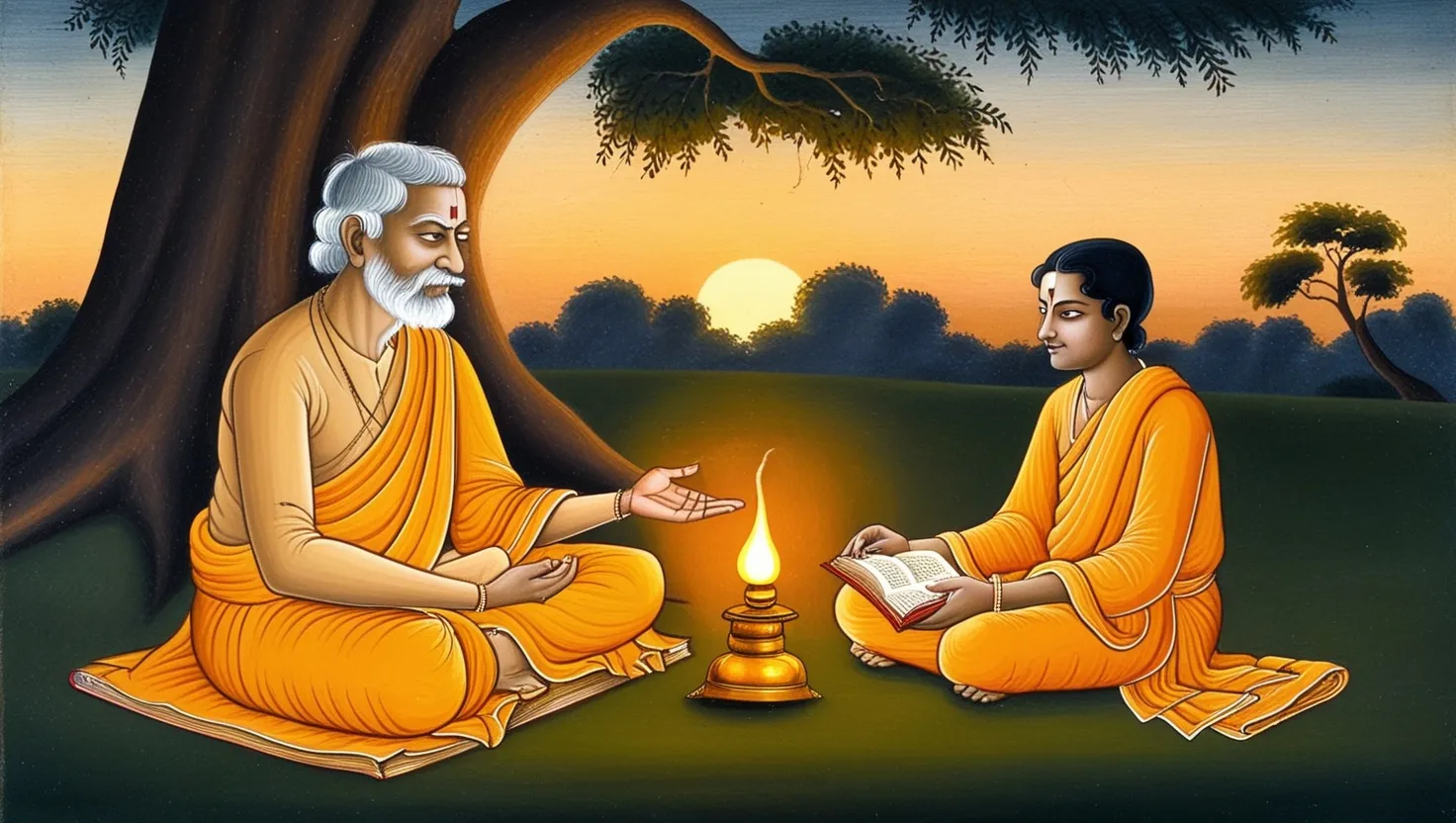
The word “parampara” literally means “one after another” — a chain of transmission passing from teacher to student across generations. But calling it a teaching chain undersells what it actually is. Think of it less like a relay race where a baton is passed and more like a flame that lights another flame. Something living moves from one person to another.
“The Guru is Brahma, the Guru is Vishnu, the Guru is Maheshwara. The Guru is the Supreme Brahman itself. Salutations to that Guru.” — Guru Stotram, Ancient Sanskrit Text
What makes this model unusual is that the Guru is not primarily a subject matter expert. A physics professor can explain quantum mechanics without living like a quantum physicist. But in the Guru-Shishya model, the teacher is expected to embody what they teach. If they are teaching you about peace, they should be peaceful. If they are teaching you about non-attachment, their own life should reflect that. The student is not just learning a concept — they are watching a proof walk around in human form.
Do you see how different this is from sitting in a lecture hall?
The Guru’s job has layers most people don’t think about. Yes, there is formal instruction. But a large part of the role is diagnosis. Every student arrives with a different mind, different fears, different blind spots. A good Guru reads the student the way a skilled doctor reads a patient — and then prescribes accordingly. One student might need silence. Another needs argument and debate. Another needs to be pushed into situations that crack their comfortable assumptions.
This is why the Gurukul system — where students lived in the teacher’s home — was so intelligent in its design. You cannot diagnose someone you see once a week for fifty minutes. You need to see them when they are tired, when they are frustrated, when they think nobody is watching. The kitchen table, the morning chores, the way someone handles a small disappointment — these become part of the curriculum.
“Tell me and I forget, teach me and I may remember, involve me and I learn.” — Benjamin Franklin
The Gurukul was not a school in our modern sense. There were no grades, no standardized tests, no graduation ceremonies with caps and gowns. There was just sustained, close-range living with someone wiser than you. Students learned philosophy by watching their teacher respond to a rude visitor. They learned humility by fetching water and sweeping floors — not as punishment but as practice.
Here is something most people miss about this tradition: the silence was educational. Sacred texts across Indian philosophy make a distinction between knowledge that is spoken, knowledge that is written, and knowledge that is transmitted through pure presence. The third kind — called “mauna diksha” in some traditions — is considered the most powerful. There are documented accounts of students sitting with a realized teacher for years, absorbing something that no lecture could have delivered.
Ask yourself — have you ever been around someone whose calm actually made you calmer? Whose confidence made you feel less afraid? That is a small taste of what the tradition is pointing at.
The relationship also created a peculiar kind of accountability that we have largely lost. A Guru was answerable to their own teacher, and through them to the entire lineage stretching back generations. This meant a bad Guru was not just failing their current students — they were breaking a chain that stretched across centuries. That weight kept things honest in a way that modern teacher-certification programs simply cannot replicate.
“One who knows does not speak. One who speaks does not know.” — Lao Tzu
What is less commonly discussed is how carefully structured the student’s side of the relationship was. The student — called the Shishya — was not a passive recipient. They were expected to bring what Sanskrit calls “shraddha,” a word often translated as faith but better understood as alert, awake receptivity. It means you show up not to argue, not to perform cleverness, but to genuinely receive. This is harder than it sounds. Most of us listen with the back of our minds already forming a response.
The Shishya was also expected to serve. Not as exploitation — a common modern misunderstanding — but as a method of ego reduction. The ego is the biggest obstacle to real learning. You cannot fill a cup that is already full, and you cannot teach someone who already believes they know. Service was the technology for creating an empty, receptive vessel.
Can you think of anyone in your own life who changed the way you think just by being around them? Not by what they said, but simply by being who they were?
The parampara model also has an interesting answer to the question of how traditions stay alive without becoming rigid. Each Guru in the chain brings their own personality, their own language, their own way of expressing the teaching. A tradition that began in a forest in ancient India finds expression centuries later in a city, through a completely different personality, using entirely different metaphors. The core is preserved; the form adapts. This is quite different from a textbook that says the same thing to every reader regardless of who they are.
“The mediocre teacher tells. The good teacher explains. The superior teacher demonstrates. The great teacher inspires.” — William Arthur Ward
There is a quiet crisis in modern education that this tradition speaks to directly. We have built systems extraordinarily good at creating people who can pass tests and follow procedures. We are less good at creating people who know who they are, who can sit with uncertainty, who respond to crisis from a place of genuine strength rather than learned behavior. Information has never been more abundant. Wisdom is, if anything, harder to find.
The Guru-Shishya model is not suggesting we dismantle universities. It is suggesting that a particular kind of learning — the kind that shapes character, not just competence — requires a different structure. It requires time, proximity, trust, and a teacher willing to bear genuine responsibility for another person’s growth.
One of the most intriguing aspects of this philosophy is where it ultimately points. The tradition does not want you to remain dependent on an external teacher forever. The highest articulation of the Guru-Shishya relationship, found across Advaita Vedanta, Shaivism, and Tantric traditions, is that the external Guru is pointing you toward something inside yourself — the “Satguru,” the inner teacher, the witnessing awareness that was never confused even when you were.
The external teacher does their job and then steps back. The student, if the transmission worked, no longer needs to be taught. They have found the source inside themselves and can now transmit it to others. The flame has lit a new flame.
“When the student is ready, the teacher appears. When the student is truly ready, the teacher disappears.” — Tao Te Ching (attributed)
This is not a tradition that romanticizes dependence or power. A Guru who keeps students permanently dependent has failed. A Shishya who worships their teacher instead of doing their own work has misunderstood the whole thing. The relationship has a built-in expiry date — not because it ends in failure, but because it ends in success.
What would change if you approached your most important relationships — with mentors, with teachers, with wise people in your life — with this kind of intentional receptivity? What might you actually absorb, not just intellectually, but into the fabric of how you live?
The Guru-Shishya Parampara is not a relic. It is a description of how deep learning actually works — slowly, through relationship, through example, through the kind of trust that only develops over time. The form may change. The principle endures.