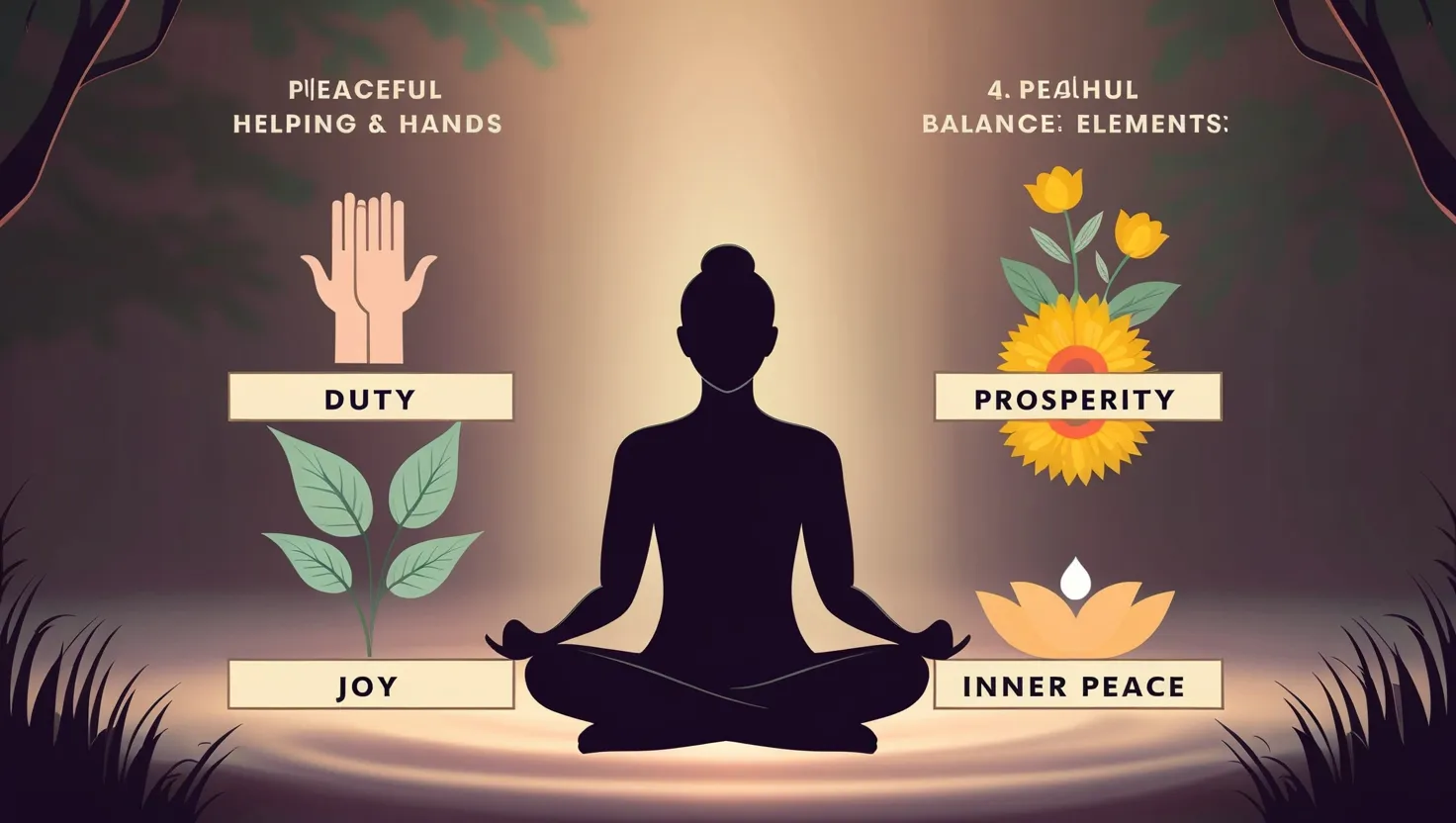
Let’s talk about something ancient, practical, and surprisingly relevant to your life—even if you’ve never thought about Hindu philosophy for a second. Imagine if you could give your life a shape, a framework that made room for survival, joy, inner peace, and doing the right thing, without forcing you to pick sides or feel guilty for wanting too much or too little. That’s exactly what the Four Purusharthas offer. I’ll walk you through them as simply as possible and show you why even in today’s world of constant distraction, their wisdom speaks in ordinary language about everyday problems.
I want you to picture your life not as a straight road with a finish line but as a table held up by four solid legs. If any one is missing, the table wobbles. That’s how Purusharthas work: Dharma, Artha, Kama, and Moksha are four aims or goals that make a person’s life whole.
“Life is a journey, not a destination.” – Ralph Waldo Emerson
Let’s start with Dharma. This isn’t about rigid rules or rituals. It’s a flexible idea. For example, the right thing for a student is to learn; for a parent, it might be to protect and guide the family; for a friend, it’s to be loyal and honest. But it’s never one-size-fits-all. Your “right thing” changes as you grow or if your life situation changes. Did you ever wonder why you sometimes feel out of place even when you follow all the “rules”? Often, it’s because your sense of what’s right is out of step with your role or stage in life.
Now, Artha. It means wealth, but not just money. Imagine a life where your basic needs are not met—food, shelter, safety. It becomes almost impossible to think about anything else, right? Hindu philosophy says go ahead—seek security and comfort. Get an education, earn a living, provide for those you care about. Having wealth is not greedy or shameful if you got it honestly and use it wisely. Here’s what’s not so obvious: the main reason Artha is included as a ‘life aim’ is because you can’t grow as a person if you’re worried about basic survival all the time.
But where’s the fun, the love, the beauty? That’s where Kama comes in. Pleasure, desire, intimacy, even enjoying music, art, or a good laugh—these all count. Many people in history tried to suppress physical and emotional joys, saying they’re distractions. Purusharthas turn that idea on its head. They say, “You want joy? Go for it, but don’t lose sight of your other aims.” Ever eaten too much cake and regretted it? That’s Kama without the balance. But if you refuse all the sweetness life offers, you miss out on being human.
What do you want more: satisfaction today, or something lasting and deeper? Is it possible to want both?
“To enjoy the things we ought and to hate the things we ought has the greatest bearing on excellence of character.” – Aristotle
Above all, there’s Moksha. Now, this is a bigger idea: freedom from cycles of wanting, gaining, losing, and suffering. Moksha isn’t death or asceticism. It’s a shift in how you see yourself and the world. Imagine for a moment not being tangled up in every worry or craving. This doesn’t mean you stop caring about your family or community. It’s more about realizing what part of yourself remains unshaken no matter what changes on the outside.
One curious thing about these four is that they don’t form a straight ladder, but more like a dance. Sometimes you chase one aim more than another. When you’re young, you might focus on Artha (learning, earning), and Kama (falling in love, friendships). As you get older, Dharma starts to matter more; you think not just about what you want, but what you owe to others. Later, many find themselves longing for Moksha, a sense of peace beyond all ambitions.
Did you ever feel guilty for wanting pleasure when working hard, or for wanting to make money instead of just “doing your duty”? This system says, stop feeling guilty. Life is not about picking which part of yourself to reject.
Most people overlook that real wisdom here is not “giving up the world,” but finding how to live in the world without misery or excess. The extreme of only chasing pleasure leads to disappointment and pain. The opposite extreme—rejecting all comfort and joy—creates a dry, anxious life. Purusharthas warn against both traps.
Here’s a question: Have you ever achieved something big—maybe got a promotion or bought something expensive—only to feel restless soon after? That’s because Artha and Kama alone can’t deliver lasting happiness. The moment you connect your achievements to a larger ‘why’—your sense of Dharma, personal growth, or even glimpses of Moksha—life feels less empty.
“In the midst of movement and chaos, keep stillness inside of you.” – Deepak Chopra
What’s surprising is how much these ideas shape daily life in cultures influenced by Hindu thought, often without people realizing it. Education systems, family traditions, even economic habits reflect a balancing act between these four goals. Children are taught to study for future security (Artha) and enjoy friendships (Kama), but also to help around the house and be gentle (Dharma). Grandparents are respected for their wisdom (linking to Moksha) rather than just their earning ability.
Did you know the famous Kama Sutra is not just about sensuality? It’s a manual that talks about ethics, relationships, and the need to keep pleasure within the bounds of love and duty. Ancient thinkers were not shy to write about joy and desire, but they always tied it back to balance and responsibility.
In my experience, once you start seeing your life through these four ideas, decision-making becomes easier. Say you face a tough career choice: Will this job give you fair pay (Artha)? Does it fit your values and help others (Dharma)? Will it leave room for family, hobbies, or love (Kama)? Is there a chance for personal growth or inner freedom (Moksha)? Suddenly, you’re not just reacting—you’re choosing with all of life in view.
What about today’s world, where success almost always means money and fame? Or where some spiritual paths tell you to abandon everything and meditate on a mountain? The Purusharthas have an answer: both are one-sided. True fulfillment involves making room for all your needs, not being forced into a narrow box. It’s fine to want comfort, even pleasure. It’s also fine to want to give back, to seek answers. Just don’t ignore any part of yourself.
Let’s look at a big question troubling many people now: How do we live well in a time of constant crisis, environmental worries, and rapid change? These four aims suggest every action—small or big—should balance personal aims and the greater good. Earning money is good, but not at the cost of fairness or the planet. Enjoying yourself is great, but not if it harms your health or well-being of others.
“If you want to change the world, start with yourself.” – Mahatma Gandhi
People today use a simplified version of Purusharthas for life coaching and therapy. Setting goals for health, relationships, career, and meaning reflects the ancient wisdom that a full life is not just about one thing. Many coaches ask clients to track not just income or achievements, but also time spent in joy, acts of kindness, and silent reflection.
I have seen the most meaningful change comes not from following rules, but from pausing to ask: “Which of these four aims am I missing right now? Is this problem just about money, or is it because I neglected duty? Am I burnt out from work because I forgot to enjoy small pleasures?” The answers almost always point back to restoring balance.
It might surprise you that some of the greatest Indian teachers stressed how important it was that everyone, regardless of status or gender, could strive for all four aims. For centuries, these ideas helped build a society where spiritual exploration wasn’t only for monks in forests. Merchants, artists, farmers, kings, and teachers each had a path and a purpose.
Do the Purusharthas mean we have to walk a tightrope forever, measuring every desire or ambition for balance? In my view, they encourage gentle self-correction, not guilt or anxiety. Missed a mark? Learn and adjust. The main thing is not to live out someone else’s story but to find your own center, returning to it whenever you feel off course.
“It is not the answer that enlightens, but the question.” – Eugene Ionesco
In a nutshell, the Four Purusharthas are a remarkably simple way to remember that life is meant to be rich, meaningful, and balanced. They remind us to live well with what we have, enjoy the moment, carry out our duties, and slowly seek that deeper quiet inside ourselves that nothing can disturb. If you find yourself confused or overwhelmed in modern life, try taking small decisions with these aims in mind. Life may not become easy, but it will feel a lot more whole.