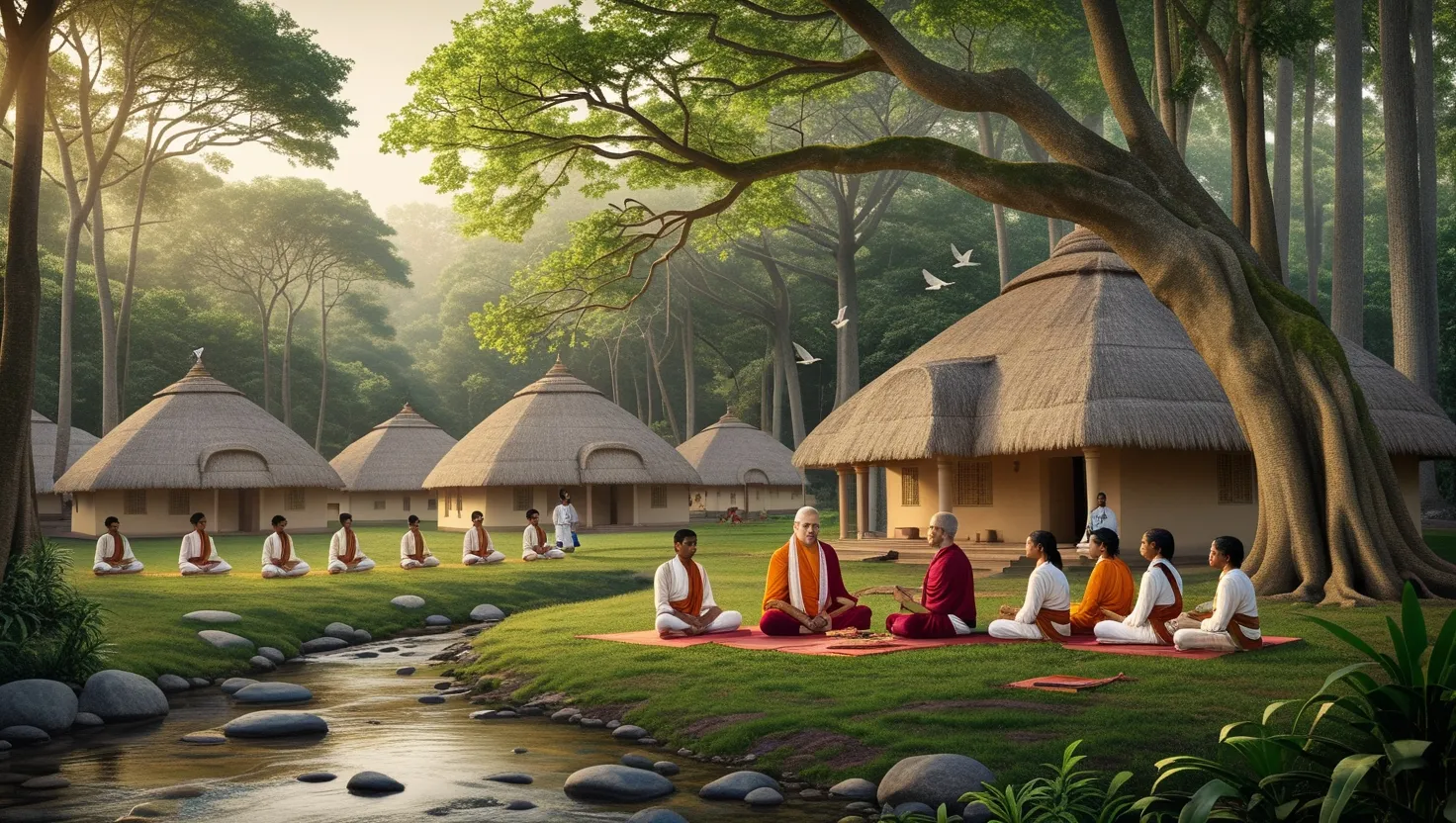
If I could invite you for a walk through an ancient Indian forest, I’d show you something quietly powerful: a humble cluster of huts, a clear stream nearby, the air alive with birdsong. In these ashrams, generations of students experienced a way of learning that hardly resembles our modern classrooms—and yet, I often wonder, might it be closer to what humans really need to thrive?
Let me take you inside this world. Imagine waking up to the distant call of a conch shell before sunrise, sharing chores and meals with fellow students, and spending your days not just poring over scriptures but debating ideas, pondering the planets, and mending fences alongside your teacher. The Gurukul system was more than an educational structure; it was a lived experience, a culture, a commitment to shared growth.
At its heart, the Gurukul was a home. Students—often children sent from distant villages or royal courts—became part of the guru’s extended family. Unlike today’s impersonal lecture halls, these students learned by observation, imitation, and immersion. They helped cook, fetch water, tend animals, and care for the infirm. Every action, from sweeping the courtyard to meditating at dawn, was a lesson in responsibility, mindfulness, and humility.
I find myself drawn to the radical idea that education here extended beyond the intellect. The focus on character was relentless. The workings of the mind were as important as the stirrings of the heart. The guru was not just a teacher of texts but a mirror for the students’ personalities, a mentor shaping their judgment, their patience, and their sense of duty.
“Education is the manifestation of the perfection already in man.” You might recognize these words from Swami Vivekananda, who often spoke of the Gurukul as the ideal. The guru’s task was to help each student discover their unique strengths. If one had a mind for mathematics, another might shine in debate or music. The curriculum flexed and changed, suited to the student’s capacity and temperament. How rare is such personalized attention today?
It surprises many that the Gurukul system was far from narrow. While the Vedas and spiritual texts were central, they sat alongside astronomy, music, medicine, grammar, architecture, and even statecraft and martial arts. Learning was both wide and deep. Recitation and memorization had their place, yet they were tools for understanding, not the end goal. The ultimate aim? Wisdom, not just knowledge.
Ask yourself: how often does a modern student find inspiration in nature, let alone connect lessons to the rhythms of the seasons or the cycle of life? In the Gurukul, the environment was the first classroom. The ashrams’ forest setting wasn’t an accident. The trees, rivers, and animals were woven into the curriculum, teaching patience, observation, and respect for all life.
Interestingly, the absence of formal tuition fees made the Gurukul strikingly accessible. Instead of money, students offered seva—service. When studies ended, a guru dakshina—sometimes as simple as a promise, sometimes a material token—would express gratitude. This approach made education a sacred duty, not a transaction. It’s a vision of schooling that breaks from today’s commodification of learning.
What did this give society? It created scholars, yes, but also citizens: people versed in cooperation, self-control, and ethical living. Many Gurukuls were open to children of all backgrounds, at least in early periods—a testament to their inclusive spirit. These spaces were vibrant centers of cultural transmission. They kept alive storytelling, arts, traditional medicine, and oral histories. One could say they were the ‘museums’ and ‘think tanks’ of their time.
Do you feel modern classrooms foster the same sense of wonder and belonging? Or are they, more often, production lines for exam scores?
Debate and discussion were cherished in the Gurukul. The practice of shastrartha—open, rigorous dialogue—was part of daily life. This encouraged not just learning facts, but shaping opinions, refining ideas, and respecting disagreement as a path to greater clarity. In an age where rote memorization often dominates, this commitment to questioning feels startlingly modern.
“Tell me and I forget. Teach me and I remember. Involve me and I learn.” Benjamin Franklin’s wisdom applies perfectly. The Gurukul system practiced what we now call experiential learning. Students learned geometry by building, botany by gardening, ethics by making hard choices in real situations. Even rituals—lighting a lamp, reciting prayers—became occasions for contemplation, discipline, and self-mastery.
What always strikes me is the way the relationship between guru and shishya (student) ran both ways. The teacher shaped the student, but the presence of honest, earnest students kept the gurus themselves disciplined, reflective, and ever-learning. Stories like that of Krishna and Sandipani, or Arjuna and Dronacharya, remind us how deep this connection could be—a model of mentorship that modern education often misses.
Was there a downside? Gurukuls could be insular, sometimes reinforcing old hierarchies. Over time, access narrowed. Still, in their early incarnations, many were surprisingly democratic by the standards of their era, including women and students from varied walks of life. Their adaptability helped them persist through centuries of change, integrating new ideas while protecting core values.
In today’s world, where education often chases utility or economic gain, the Gurukul’s holistic vision provides a sharp contrast. Well-being was measured as much by inner balance as by outward achievement. Minimalism and shared living fostered resourcefulness. The minimal use of materials, reliance on the forest, and collective stewardship of resources suggest a sustainability ethic rarely matched by even our greenest campuses.
How might we bring this spirit into the present? Some contemporary schools have adapted the Gurukul template. They prioritize dialogue, require community service, and integrate meditation or yoga. But the lesson goes beyond methods. It’s an attitude: seeing students as whole people, nurturing their minds, bodies, and spirits—not just feeding them facts.
Mark Twain once wrote, “Don’t let schooling interfere with your education.” The Gurukul reminds us that true learning is vast, ongoing, and not easily measured. Students here grew up with a sense of confidence, purpose, and connection—qualities that standardized testing can never capture.
I realize this paints an idealized picture. The Gurukul was not perfect. But its best qualities—the fusion of the practical and the profound, the reverence for the teacher-student bond, the use of nature as a living textbook—still carry lessons. At a time when anxiety and alienation among students are rising, might this be the model to revisit?
The Gurukul system asks us: what does it mean to be educated? Is it merely to memorize information, or is it to grow in wisdom, character, and a sense of service to the world?
Perhaps it’s time to move beyond narrow definitions and rediscover the power of learning as a way of living, not just a way of knowing.